@claudeai Opus 4.8 is now available on AWS. @AnthropicAI's most advanced Opus model brings an upgrade to autonomous operation. Opus 4.8 can hold a plan across stages, track progress, and self-correct when something breaks—designed for multi-stage tasks that run for hours. Access Opus 4.8 on Amazon Bedrock for specific data residency requirements and Bedrock-native features, or through Claude Platform on AWS for Anthropic's native platform experience.
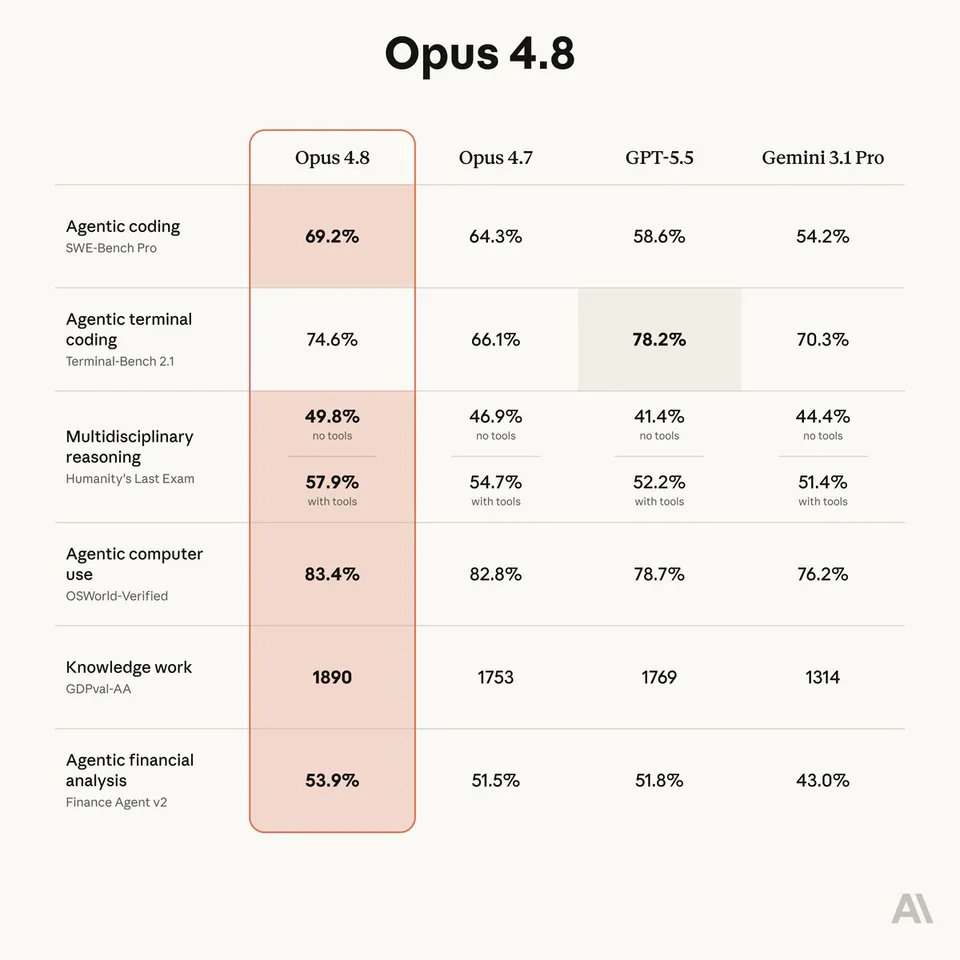
AWS Launches Claude Opus 4.8 With Self Correcting Autonomous Planning
AWS integrated
Claude Opus 4.8, the latest frontier model from Anthropic, into Amazon Bedrock alongside the Claude Platform on AWS launch. This release introduces autonomous operation, where the model maintains a persistent plan across multi-hour execution stages. It navigates complex codebases and handles deep knowledge work with minimal human oversight.- Model
- Claude Opus 4.8
- Key capability
- Self-correcting autonomous planning
- Bedrock regions
- US East, Tokyo, Ireland, and others
- API support
- Messages API, Converse API
- Availability
- Amazon Bedrock, Claude Platform on AWS
This update addresses the reliability gap in long-running agentic loops where a single failure typically halts the process. By introducing self-correction, Opus 4.8 enables more predictable behavior for enterprise AI agents. It follows the Claude Opus 4.7 self-verification release by sustaining coherence over multi-step dependency chains.
Access Opus 4.8 today via the Amazon Bedrock console or programmatically through the bedrock-runtime endpoint. Regional availability includes US East, Tokyo, Ireland, and Stockholm for Bedrock. The model supports the Anthropic Messages API and the unified Bedrock Converse API for multi-model workflows.
AWS AI
@AWSAI
Still wondering? A few quick answers below.
Claude Opus 4.8 is Anthropic's most advanced frontier model, now available on AWS. It is specifically designed for long-running autonomous tasks, such as agentic coding and deep research. The model can maintain complex plans across multiple stages and operate independently for hours, making it a significant upgrade for production workflows that require sustained reasoning.
The self-correction mechanism allows Claude Opus 4.8 to track its own progress and adjust its plan when it encounters an error. Instead of stopping execution and surfacing an error message, the model can identify what broke and attempt to fix the issue autonomously. This leads to more predictable behavior and fewer required review cycles in multi-step workflows.
You can access the model through Amazon Bedrock in regions including US East (N. Virginia), Tokyo, Ireland, and Stockholm. It is also available via the Claude Platform on AWS across North America, South America, Europe, and Asia Pacific. Users can test the model in the Bedrock console playground or call it programmatically using the Anthropic Messages API.
The model is optimized for industries where consistency and depth are critical, such as financial services, legal, and cybersecurity. Specific tasks include investment research, contract review, and vulnerability finding. Its ability to navigate real codebases and hold long traces in context makes it particularly effective for autonomous coding and complex, multi-stage agentic workflows.
Yes, developers can access Claude Opus 4.8 programmatically using the AWS SDK or Command Line Interface. It supports the Anthropic Messages API to call the bedrock-runtime through the Anthropic SDK. Additionally, the model is compatible with the Amazon Bedrock Converse API, which provides a unified experience for managing multi-model conversations and inference configurations.