HeadsUpAI

OpenClaw Integrates Claude Opus 4.8 and Cuts Core Footprint by Half

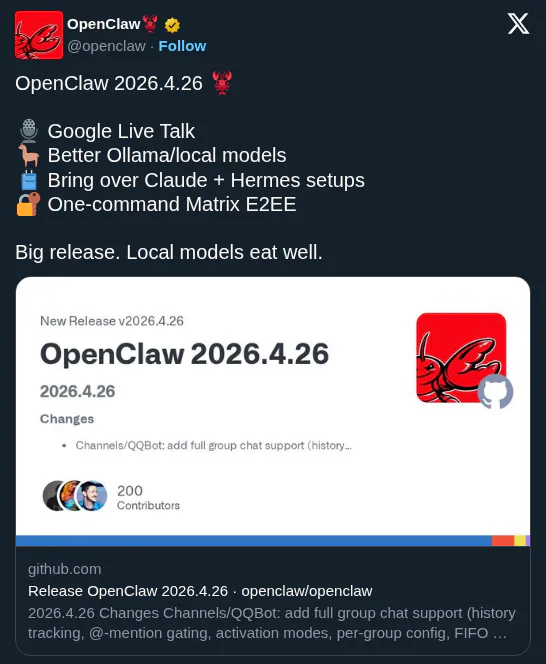
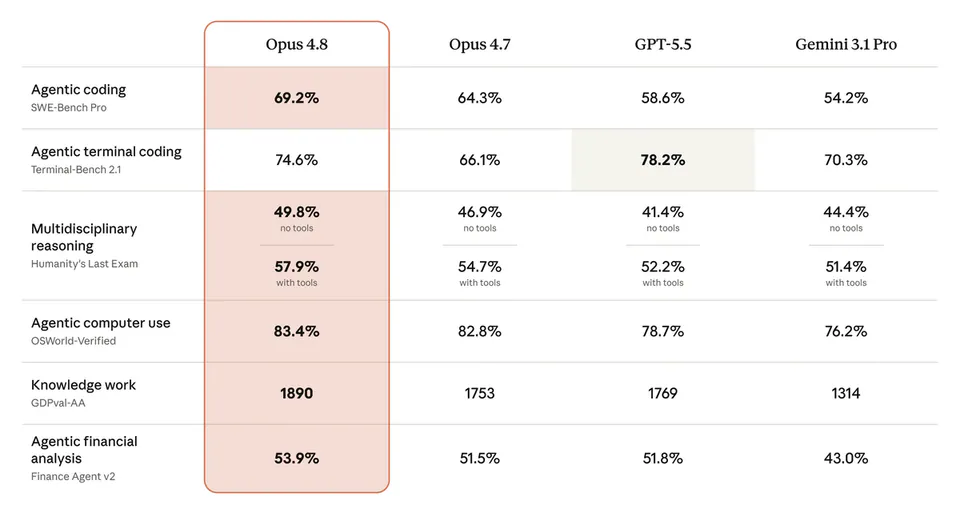
OpenClaw, an open-source self-hosted AI assistant that orchestrates agents across messaging platforms, released version 2026.5.28 with native support for Claude Opus 4.8. The update also integrates Krea image models via fal and introduces a /subagents command to inspect active child runs, building on OpenClaw's durable task flow orchestration.
Cold turn performance
14.5% faster
Warm turn performance
16.0% faster
Fresh install size
52.8% smaller
Package roots
371 to 300

This release shifts the platform from the security-focused OpenClaw 2026.5.27 hardening update toward aggressive performance optimization. By cutting the fresh install size by 52.8%, the team is addressing the resource bloat often associated with self-hosted systems. Faster hot paths for gateways and sessions directly reduce the latency that stalls autonomous agent loops.

You can now wire Krea models into image workflows or use Discord progress drafts to view assistant commentary during tool runs. The update also hardens Codex (the platform's agentic coding mode), ensuring helper failures no longer crash shared runtime states. Version 2026.5.28 is available now via GitHub, Docker, and npm.

OpenClaw🦞
OpenClaw🦞
@openclaw
X

OpenClaw 2026.5.28 is live 🧠 Claude Opus 4.8 support 🎨 Krea image model support via fal ⚡ faster Gateway/plugin/session hot paths 💬 Discord progress drafts now show commentary Sharper models, livelier runs. https://t.co/Jt8wsFjTqm

52retweets426likes
View on X

Still wondering? A few quick answers below.

This update introduces native support for the Claude Opus 4.8 model and Krea image generation via the fal infrastructure. It also features a significant performance overhaul that reduces the installation size by over 50% and optimizes hot paths to deliver up to 16% faster response times during active agent sessions.

Users can now use the subagents command to inspect the status of active child runs. This tool provides visibility into specific labels, session timestamps, and tool logs, making it easier to debug complex delegation. Additionally, Discord progress drafts now display assistant commentary to show real-time activity during long-running tool executions.

The Codex agentic coding mode received several reliability fixes to ensure steadier performance. Subagents now maintain better workspace separation, and session locks are designed to release properly during timeout aborts. These changes prevent helper failures from tearing down shared runtime state, allowing the assistant to recover more gracefully from errors.

Yes, OpenClaw remains an open-source, self-hosted platform that users can run on their own hardware. The latest version is available as a public release on GitHub and can be deployed using Docker or installed as an npm package. This version is specifically optimized to be lighter and faster for local installations.

OpenClaw supports image generation through various providers, and the 2026.5.28 update specifically adds support for Krea image model schemas via fal. These models can be integrated directly into the existing image generation workflow, allowing the assistant to create or manipulate visual content across supported messaging channels like Discord and Telegram.

Share this update