OpenAI Adds Reasoning and Tool Use to GPT Realtime mini Models

OpenAIOpenAI

OpenAI launched GPT-Realtime-2.1-mini, adding reasoning and tool use capabilities to its low-latency voice model lineup. The update improves response speeds across all Realtime voice models through improved caching while maintaining cost parity with previous versions.

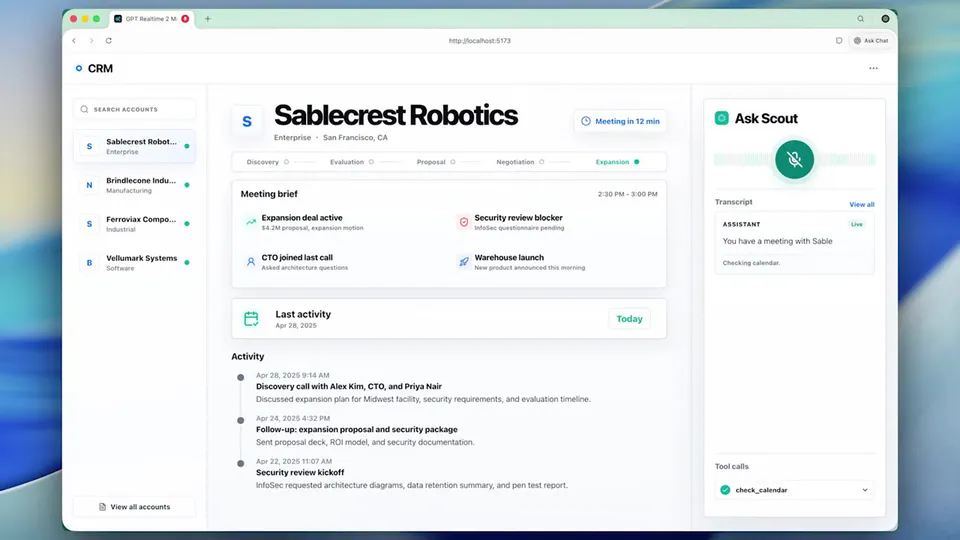
OpenAI released GPT-Realtime-2.1-mini, an update to its low-latency speech-to-speech model that introduces reasoning and tool use. This allows voice agents to perform internal chain-of-thought reasoning (step-by-step logic before responding) and invoke external functions during live conversations. The model maintains cost parity with the previous version.

This update bridges the gap between high-intelligence reasoning models and the low-latency requirements of voice interaction. Previously, developers chose between fast, reactive voice responses or slower, more capable reasoning. By integrating these features into the "mini" lineup, OpenAI enables complex agentic behavior in real-time applications without typical latency or cost penalties.

Developers can access the model via the Realtime API using the gpt-realtime-2.1-mini identifier. A new reasoning.effort parameter allows for tuning deliberation time based on task complexity. The release also includes significant speed improvements for all Realtime voice models, driven by improved prompt caching (reusing previously processed context to save time and cost).

OpenAI Developers
OpenAI Developers
@OpenAIDevs
X

GPT-Realtime-2.1-mini is now available in the API, bringing reasoning and tool use to our Realtime mini lineup at the same cost as GPT-Realtime-mini. https://t.co/fOyeYeYkiV

134retweets2.3klikes
View on X

Still wondering? A few quick answers below.

GPT-Realtime-2.1-mini is a low-latency speech-to-speech model from OpenAI designed for the Realtime API. It is the first model in the mini lineup to support reasoning and tool use, allowing voice agents to think through complex logic and interact with external functions during a live conversation without switching to a text-based model.

Reasoning in the Realtime API allows the model to perform internal chain-of-thought processing before generating a spoken response. Developers can control this behavior using a reasoning effort parameter, which can be set to low for faster production responses or adjusted based on the specific latency tolerance and task complexity of the voice application.

OpenAI has reduced p95 latency by at least 25 percent across its entire lineup of Realtime voice models. This performance boost is achieved through improved prompt caching, which allows the system to reuse previously processed context more efficiently. These speed gains apply to the new 2.1-mini model as well as existing voice-agent sessions.

OpenAI has launched GPT-Realtime-2.1-mini with cost parity in mind for developers. The new model, which includes advanced reasoning and tool use capabilities, is available at the same price point as the previous GPT-Realtime-mini. This allows developers to upgrade their voice agents with more sophisticated logic without increasing their API usage costs.

Developers can access the new model through the OpenAI API using the gpt-realtime-2.1-mini model identifier. It supports multiple connection methods including WebRTC for browser and mobile applications, WebSockets for server-side media pipelines, and SIP for telephony systems. The model is currently available for building voice agents, live translation services, and transcription workflows.

Every HeadsUpAI update is written based on its original source and reviewed before it's published. Read our editorial standards →

Share this update