SynthID, our imperceptible watermark for AI-generated content, is expanding to more partners. We’re also adding new ways to find out if content was generated using AI - just ask in the @GeminiApp or in @Google Search. https://t.co/L547EVMqIv
Google Expands SynthID Watermarking to OpenAI and Launches Native Verification Tools
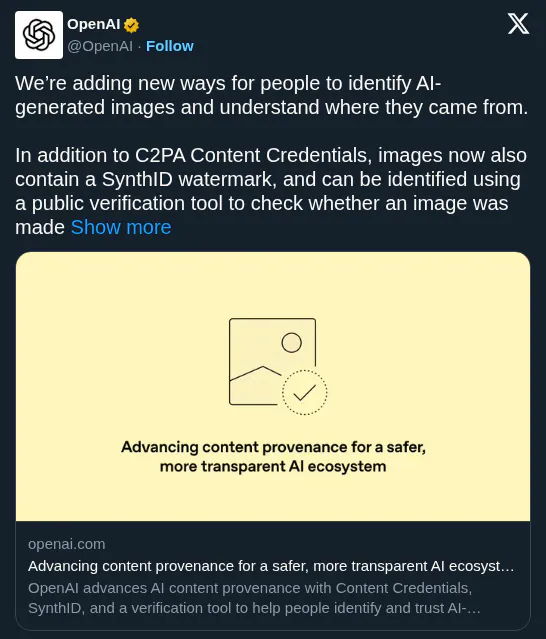
Google is scaling its content transparency ecosystem by expanding SynthID—an imperceptible digital watermark—to partners like OpenAI and ElevenLabs. This follows OpenAI's implementation of SynthID watermarks. Google is also launching native verification features in Search, Chrome, and the Gemini app.
- SynthID partners
- OpenAI, ElevenLabs, Kakao
- Verification platforms
- Gemini, Google Search, Chrome
- C2PA video support
- Pixel 8, 9, and 10
- Enterprise access
- AI Content Detection API
- Cross-platform labeling
- Pixel photos on Instagram
This shift moves AI detection from fragile metadata to resilient, invisible signals that survive file compression. By partnering with Meta, Google is establishing a cross-industry standard where authentic media is as verifiable as synthetic content. This creates a provenance-by-default environment that protects human creators while making synthetic media harder to pass off.
You can now use Circle to Search or Gemini to verify media origins, with C2PA Content Credentials coming to Search soon. Developers can access the new AI Content Detection API on Google Cloud to moderate synthetic media. Video provenance is also coming to Pixel 8, 9, and 10.
Google DeepMind
@GoogleDeepMind
32retweets225likes
View on XStill wondering? A few quick answers below.
SynthID is a digital watermarking technology developed by Google DeepMind that embeds imperceptible signals directly into AI-generated images, videos, audio, and text. Unlike traditional metadata that can be easily stripped away, these invisible watermarks are designed to remain detectable even after the content has been edited, compressed, or cropped by users.
Google is expanding the reach of its watermarking technology through partnerships with other major AI providers. Companies including OpenAI, ElevenLabs, and Kakao are integrating SynthID into their own generative models. This industry-wide adoption aims to create a consistent standard for identifying synthetic media across different platforms and AI tools.
You can verify the origin of content by asking Gemini, Google Search, or using Chrome. Features like Circle to Search and Google Lens allow you to ask if an image is AI-generated. Google is also integrating C2PA Content Credentials to show if media is an unaltered original from a camera.
The AI Content Detection API is a new tool launched on Google Cloud’s Gemini Enterprise Agent Platform. It allows businesses and organizations to programmatically identify AI-generated media created by Google and other popular models. This helps platforms manage content moderation, perform fact-checking, and prevent fraud by identifying synthetic media at scale.
Pixel 10 was the first smartphone to include native C2PA Content Credentials for images. Google is now expanding this capability to include video for Pixel 8, 9, and 10 devices. This technology documents when content is captured by a camera, helping users prove that their photos and videos are authentic and unedited.