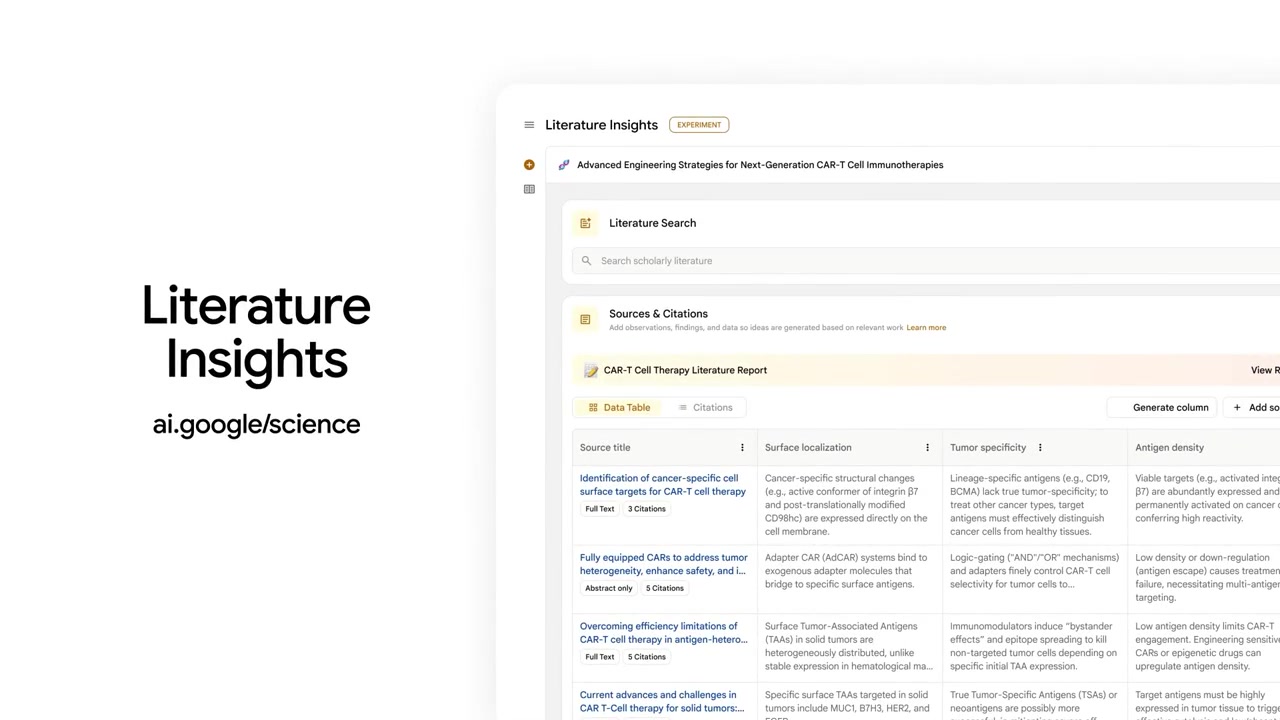
Deep Research and Deep Research Max are our latest autonomous research agents powered by Gemini 3.1 Pro. They can safely navigate both the web and your custom data, like internal docs and specialized financial information, to create professional-grade, fully cited reports. 🧵
Google DeepMind Launches Deep Research Agents for Autonomous Reporting and Data Analysis
Google DeepMind· Updated
Google DeepMind launched Deep Research and Deep Research Max, two autonomous agents powered by Gemini 3.1 Pro that navigate the web and private datasets to generate cited reports. These agents move beyond simple chat by using extended reasoning and arbitrary MCP support to synthesize complex information into professional-grade documents with native visualizations.
Gemini 3.1 Pro that perform multi-step analytical tasks. These agents browse the web or private data to produce cited reports. This release includes support for the Model Context Protocol (MCP), a standard for connecting AI to external data.- Underlying model
- Gemini 3.1 Pro
- Performance tiers
- Deep Research, Deep Research Max
- Connectivity protocol
- Model Context Protocol (MCP)
- Output formats
- Cited reports, native visualizations
- Data sources
- Web, internal docs, financial data
- Availability
- Gemini API
This update shifts focus to test-time compute (allocating more processing power during inference to improve reasoning). By offering a "Max" tier, the team addresses the reliability gap in agentic workloads requiring deep context gathering. Native visualizations also bridge the gap between raw data and presentation-ready outputs.
Integrate these agents via the Gemini API to automate market research or internal knowledge synthesis. Deep Research is optimized for speed, while Deep Research Max handles complex, long-running background research. Both tiers are available for developers to build custom research tools that leverage private enterprise data.
Still wondering? A few quick answers below.
Every HeadsUpAI update is written based on its original source and reviewed before it's published. Read our editorial standards →