HeadsUpAI

Fireworks AI Research Shows Hybrid Agents Outperform Monolithic Frontier Models

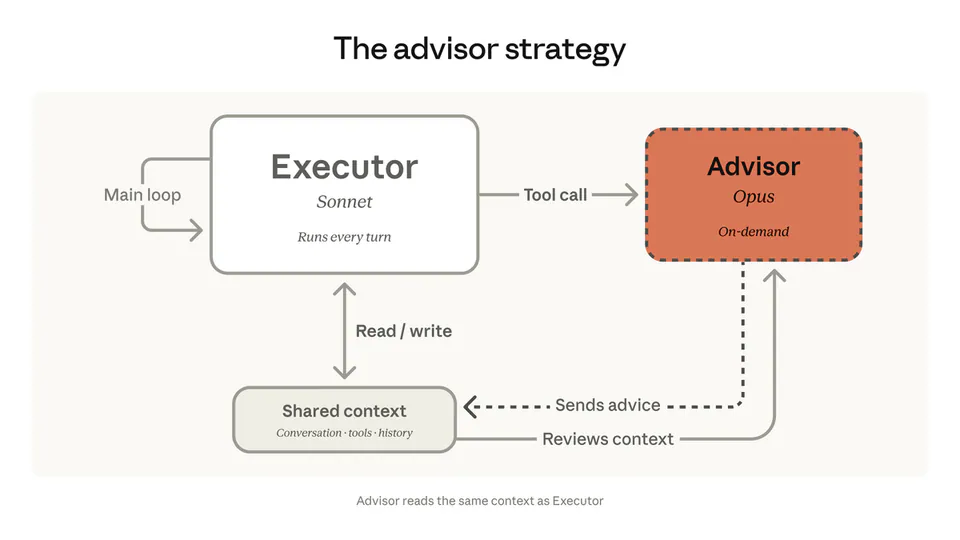
Fireworks AI research on a "Frontier Advisor" pattern shows open-weight models can beat frontier systems through orchestration. Using Harvey's Legal Agent Benchmark, a GLM 5.1 worker model invoked Claude Opus 4.7 for difficult sub-tasks. This hybrid harness achieved an 18/100 all-pass score (where every rubric criterion must be met), surpassing standalone Claude Opus 4.7.
GLM 5.1 + Opus 4.7 All-Pass
18/100
Claude Opus 4.7 Standalone All-Pass
14/100
Hybrid Harness Cost
$368
Claude Opus 4.7 Standalone Cost
$954
Advisor Invocation Rate
0.83 times per task

This shift addresses the execution tax where expensive models drain budgets. While frontier models like Claude Opus 4.7 are powerful, their cost often makes them impractical for long-horizon workflows. Sparse advisor calls reach frontier-level performance at 39% of the cost, proving that orchestration matters more than raw model size.

Teams can implement these patterns on the Fireworks AI platform, which supports reinforcement fine-tuning (training against evaluators directly with rewards) to align models with domain rubrics. Research showed that post-training Kimi K2.6 on the same infrastructure improved its all-pass score to 15/100. This unified stack ensures bit-for-bit parity when deploying custom agents.

Fireworks AI
Fireworks AI
@FireworksAI_HQ
X

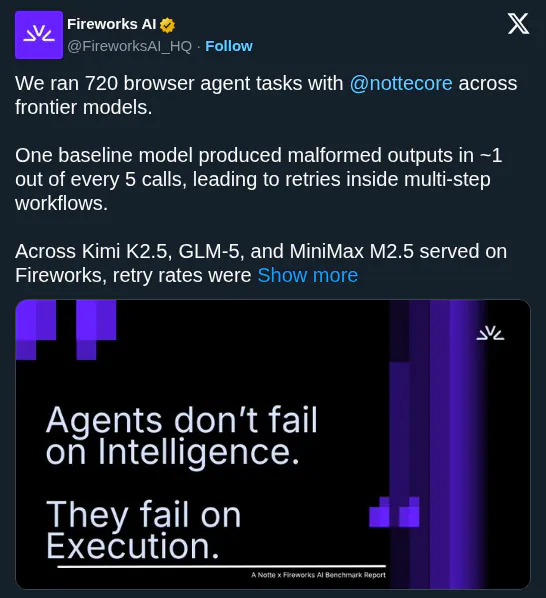
Frontier models are powerful advisors. On @harvey's Legal Agent Benchmark, a GLM 5.1 worker using Claude Opus 4.7 as a sparse advisor reached 18/100 all-pass versus 14/100 for Opus alone, at 39% of the cost. More on the harness design, advisor pattern, and training results: https://t.co/ozxFycdzcT

4retweets22likes
View on X
Still wondering? A few quick answers below.

The Frontier Advisor pattern is a multi-agent architecture where a cost-effective open-weight "worker" model performs the bulk of a task and only calls a high-intelligence "frontier" model for specific guidance. This sparse use of expensive models allows the system to achieve frontier-level accuracy on complex sub-tasks while maintaining significantly lower overall inference costs.

Harvey's Legal Agent Benchmark uses two primary metrics: mean score and all-pass. Mean score represents the average percentage of rubric criteria a model satisfies across all tasks. All-pass is a stricter production-readiness metric where a task is only considered successful if the model meets every single expert-written criterion in the rubric.

The Fireworks AI platform provides a unified infrastructure for training, evaluating, and serving models. It supports supervised fine-tuning (SFT) and reinforcement fine-tuning (RFT) at massive scales, such as the trillion-parameter Kimi K2.6. This allows developers to move from experimental fine-tuning to production deployment on the same endpoint without experiencing numerical drift or accuracy loss.

In legal practice, a deliverable that is only partially accurate can be materially incomplete or misleading. For example, a deal-team report that identifies eight out of ten risks is not 80% useful; it is a failure. The all-pass metric ensures a model satisfies every expert-written criterion in a task before it counts as a success, reflecting the production standard that legal work demands.

Every HeadsUpAI update is written based on its original source and reviewed before it's published. Read our editorial standards →

Share this update