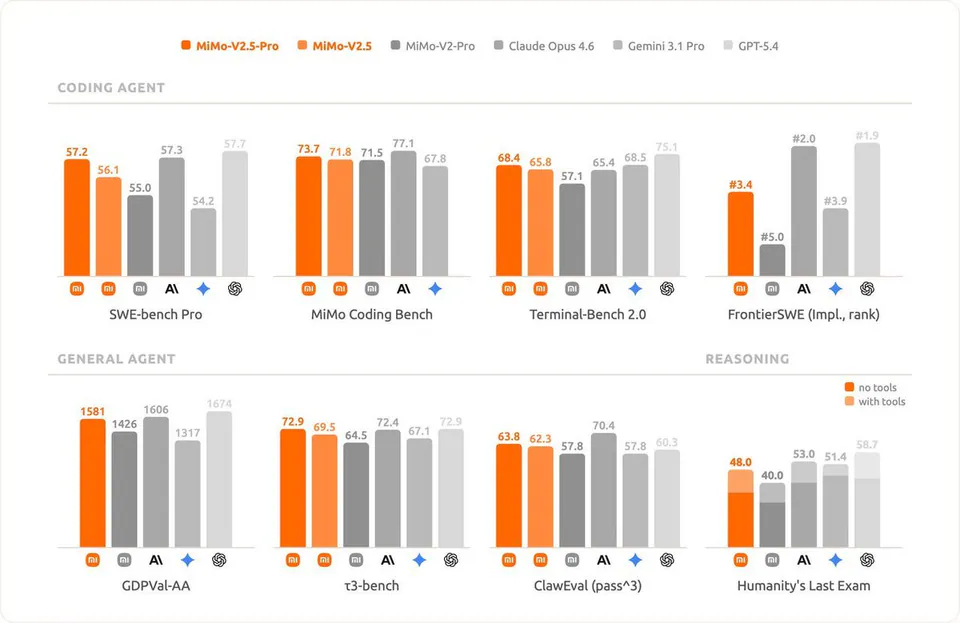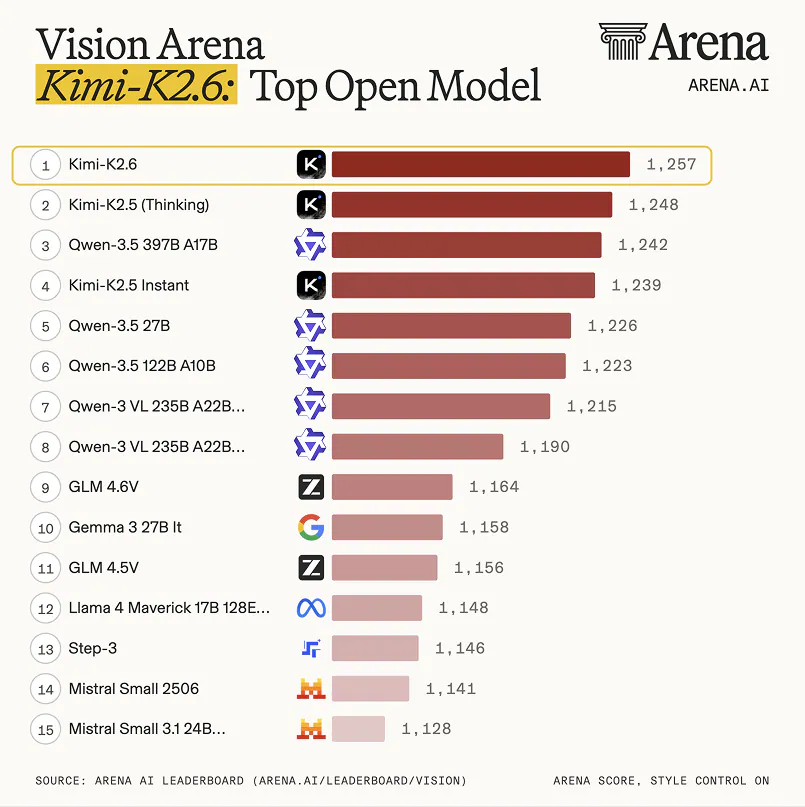
MiMo-V2.5 by @XiaomiMiMo is the #11 model (#3 among open) in Code Arena for frontend design. A new MIT-licensed open source model with 1M context, it also ranks strongly as an open model in Text and Vision Arena. Code Arena: frontend webdev design - MiMo-V2.5-Pro: #3 open (#11 overall) - MiMo-V2.5: #5 open (#18 overall) Text Arena: text prompts - MiMo-V2.5-Pro: #2 open (#22 overall) Vision Arena: visual input reasoning MiMo-V2.5: #7 open (#37 overall) Congrats to the @XiaomiMiMo team on this achievement!
Arena.ai Ranks Xiaomi MiMo-V2.5 as Top Open Source Coding Model
Arena.ai, an AI evaluation platform, validated Xiaomi's new MiMo-V2.5-Pro as the #3 open-weight model for frontend web design. Their community-driven benchmarks found that the model, featuring a 1-million-token context window (data processed at once), ranks strongly across text and vision. This mirrors OpenRouter's MiMo-V2.5 launch.
- Context window
- 1 million tokens
- License
- MIT License
- Code Arena Rank (Open)
- #3
- Text Arena Rank (Open)
- #2
- Architecture
- Sparse Mixture of Experts
- Modality
- Omnimodal
These findings confirm that Xiaomi's sparse Mixture of Experts architecture (activating only relevant model parts) delivers frontier-level performance without restrictive licensing. The validation proves that these models compete with proprietary systems in complex coding, following DeepSeek V4 Pro's leaderboard entry which showed similar gains for open-weight models.
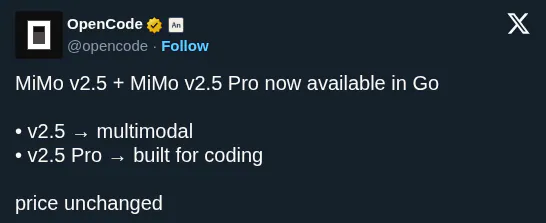
This provides a high-performance commercial alternative under the permissive MIT license. You can deploy the flagship MiMo-V2.5-Pro or the standard MiMo-V2.5 for agentic workflows. Both are available on Hugging Face and supported by OpenCode, matching OpenCode's agentic platform.
Arena.ai
@arena
38retweets342likes
View on XStill wondering? A few quick answers below.
Xiaomi released the MiMo-V2.5 series under the MIT License. This is a highly permissive open-source license that allows for commercial deployment, continued training, and fine-tuning without requiring additional authorization from Xiaomi. This makes the models particularly attractive for developers and businesses looking to build proprietary applications on top of frontier-level AI.
In the Arena.ai Code Arena for frontend web development, MiMo-V2.5-Pro is ranked as the #3 open-weight model and #11 overall. In the Text Arena, it holds the #2 spot among open-weight models. These rankings are based on community-driven, blind human evaluations, validating the model performance against both open and proprietary competitors.
Both the MiMo-V2.5 and MiMo-V2.5-Pro models support a massive 1-million-token context window. This large capacity allows the models to process and reason across extensive datasets, such as entire codebases, long documents, or complex multi-step agentic workflows, without losing track of information from the beginning of the input.
Xiaomi released two primary versions: MiMo-V2.5 and MiMo-V2.5-Pro. The Pro version is specifically architected for complex agentic tasks and high-performance coding, while both models are native omnimodal systems. This means they can process multiple types of data, including text, images, and vision-based reasoning, within a single unified architecture.
Yes, the MiMo-V2.5 series is natively omnimodal, supporting text, vision, and visual input reasoning. In the Vision Arena leaderboard, which measures a model ability to reason about visual data, MiMo-V2.5 is ranked as the #7 open-weight model. This capability allows it to handle tasks that require understanding both code and visual design elements.