HeadsUpAI

Oracle AI Agent Memory Gives Production Agents a Governed Database Core

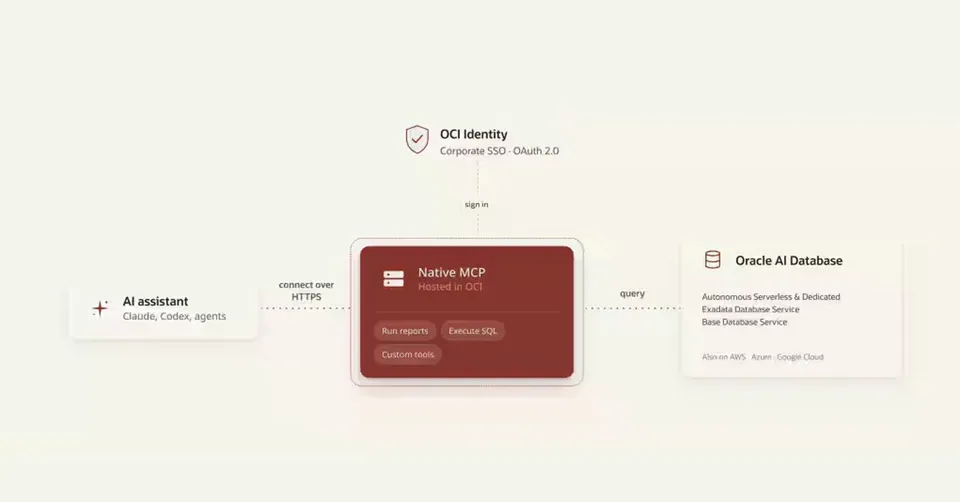
Oracle, the enterprise database provider, launched Oracle AI Agent Memory, a Python package providing a unified memory core for production agents. It expands on Oracle's OCI Managed MCP Service by consolidating working, semantic, and procedural memory into one substrate. This replaces fragmented stacks of vector stores and chat logs with one governed backend.
Recall accuracy (LongMemEval)
93.8%
Token reduction (80-turn session)
9.5x lower usage
Temporal reasoning recall
96.2%
Knowledge update recall
94.9%
Multi-session recall
88.0%

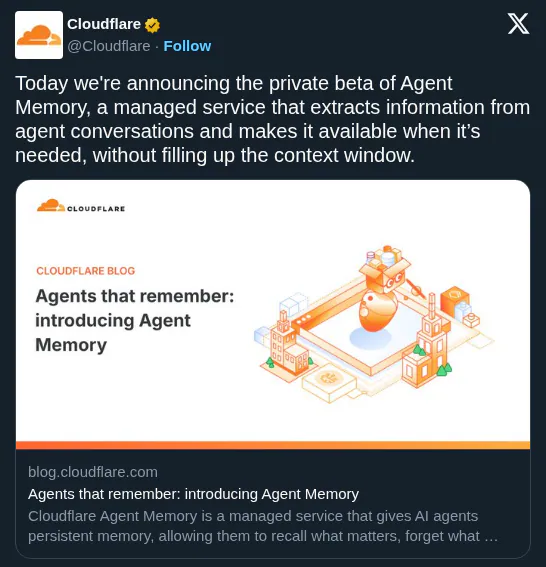
As developers move toward autonomous agents, managing persistent state across long sessions is a bottleneck. This update joins Cloudflare's Agent Memory service in moving state management to a transactional database layer. It uses automatic extraction to turn conversations into durable memories, reducing token usage by roughly 90% in extended sessions.

The package is model-agnostic and integrates with LangGraph and the OpenAI Agents SDK. You can install it via pip install oracleagentmemory to implement per-user memory isolation and auditing. It is available now for teams running Oracle AI Database to move agentic workflows from prototypes to regulated production.

Oracle Developers
Oracle Developers
@OracleDevs
X

Oracle AI Agent Memory is a new Python package for building agents that can recall, adapt, and forget context using Oracle AI Database as the memory core. Install it with: pip install oracleagentmemory Model agnostic. Framework agnostic. Built for production AI agents. https://t.co/DEBf1Ci7pl

3retweets5likes
View on X

Still wondering? A few quick answers below.

Oracle AI Agent Memory is a Python package designed to provide a unified memory layer for enterprise AI agents. It uses Oracle AI Database as a central core to manage four types of agent state: working memory for active reasoning, semantic memory for facts, episodic memory for past experiences, and procedural memory for behavioral rules and guidelines.

The package uses periodic summarization and durable memory extraction to keep the working context bounded. In testing, this approach held per-request input to 1,300 tokens over 80 turns, while a flat-history baseline grew to 13,900 tokens. This represents a 9.5x reduction in per-request costs for long-running agent sessions.

The package is framework-agnostic and designed to work with any Python runtime. It includes specific integration support and how-to guides for LangGraph, the Claude Agent SDK, and the OpenAI Agents SDK. Developers can also use it within custom Python harnesses by instantiating the standard client to read from and write to the database store.

Built for production, the system provides multi-tenant isolation and native auditing through Oracle AI Database. Every record includes user and thread scoping fields, allowing developers to locate and delete specific memories. This enables teams to comply with data erasure requests or right to be forgotten requirements within a single governed substrate.

You can install the package using the standard Python package manager with the command pip install oracleagentmemory. Once installed, you can initialize the memory client using a connection string to your Oracle AI Database instance. The SDK then provides high-level APIs for creating conversation threads, adding messages, and automatically extracting durable long-term memories using LLMs.

Share this update