OpenAI
@OpenAI
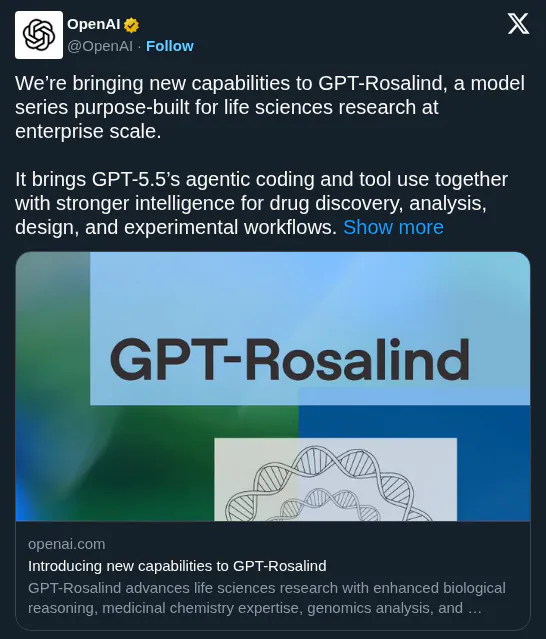
Introducing GPT-Rosalind, our frontier reasoning model built to support research across biology, drug discovery, and translational medicine. https://t.co/PubLU0FkSv
435retweets5.1klikes
View on X OpenAI
· Updated
OpenAI introduced GPT-Rosalind, a frontier reasoning model purpose-built for biology, drug discovery, and translational medicine. The model series is optimized for complex scientific workflows, outperforming GPT-5.4 on specialized benchmarks for protein engineering and genomics.
Drug discovery typically takes over a decade, slowed by fragmented data and complex workflows. GPT-Rosalind provides a specialized orchestration layer that reasons across literature and databases simultaneously. It currently outperforms GPT-5.4 on specialized benchmarks like LABBench2, specifically in tasks requiring end-to-end design of molecular cloning protocols.
The Life Sciences research plugin for Codex functions as an orchestration layer, connecting the model to over 50 specialized databases and tools. This integration enables automated workflows for protein structure lookups, sequence searches, and literature reviews, allowing researchers to move from raw data to grounded discovery decisions within a single environment.
Introducing GPT-Rosalind, our frontier reasoning model built to support research across biology, drug discovery, and translational medicine. https://t.co/PubLU0FkSv
Every HeadsUpAI update is written based on its original source and reviewed before it's published. Read our editorial standards →