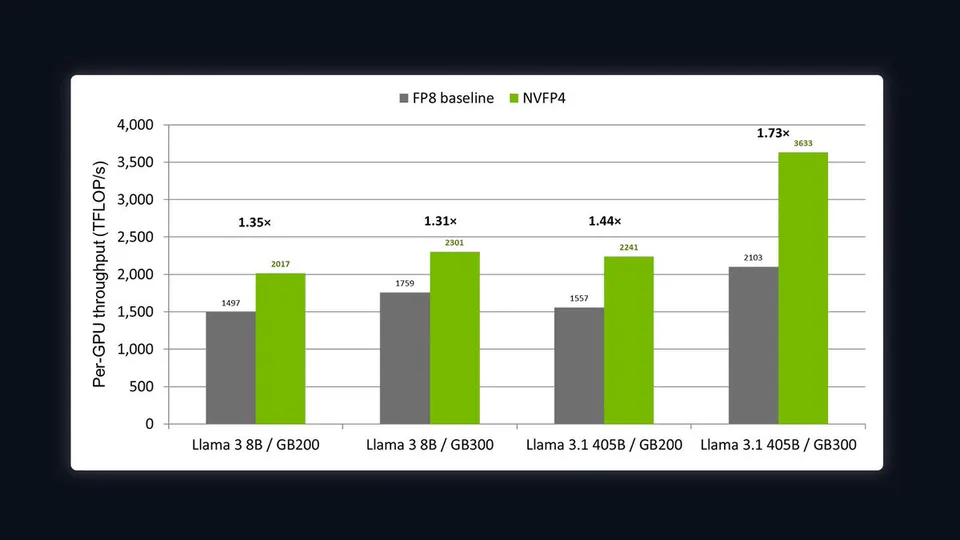
NVIDIA released LongLive-2.0, an end-to-end infrastructure that uses 4-bit floating point precision across the entire training and inference lifecycle for long-form video. By aligning 4-bit weights and activations with a multi-shot attention mechanism, the system achieves real-time speeds while maintaining subject consistency over minute-long generations.
NVIDIA introduced LongLive-2.0, a parallel infrastructure that brings 4-bit floating point (NVFP4) precision to the entire long-video generation workflow. Unlike standard methods that quantize models after training, this system uses 4-bit-aware training and distillation to ensure the model is optimized for low-precision deployment from the start.
- Inference speed
- 45.7 FPS (GB200)
- Training speedup
- 2.1x over BF16
- Peak memory
- 19.4GB (NVFP4 KV cache)
- Resolution
- 720p
- Availability
- GitHub (Code, Models, Paper)
Long video generation is a systems challenge because memory and compute requirements scale sharply with duration. LongLive-2.0 addresses this by implementing W4A4 inference and an NVFP4 KV cache, reducing peak memory to 19.4GB. This efficiency enables real-time long-video generation on NVIDIA Blackwell hardware at 45.7 frames per second.
You can generate 720p video with consistent subjects across multiple shots using a new multi-shot attention sink. The framework supports prompt switching at chunk boundaries, making it suitable for complex, minute-scale storytelling. NVIDIA has released the full project, including the research paper, code, and pre-trained models, on GitHub for immediate implementation.