Google Nano Banana Pro Achieves Spatial Accuracy for 3D Printing
Google·
· Updated
Google's Nano Banana Pro image model demonstrated the ability to maintain strict brand identity and spatial volumes precise enough for 3D printing. This shift moves AI image generation from visual illustration toward functional industrial design and physical prototyping.
Google shared findings from a stress test of Nano Banana Pro, its high-fidelity image generation model. Working with design firm Porto Rocha, the team built a hypothetical brand to evaluate the model's ability to maintain identity persistence and spatial volumes across diverse creative assets.
Model name
Nano Banana Pro
Output resolution
4K
Key capability
Spatial accuracy for 3D printing
Availability
Google Cloud, Google AI Studio
Reference blending
Up to 14 images
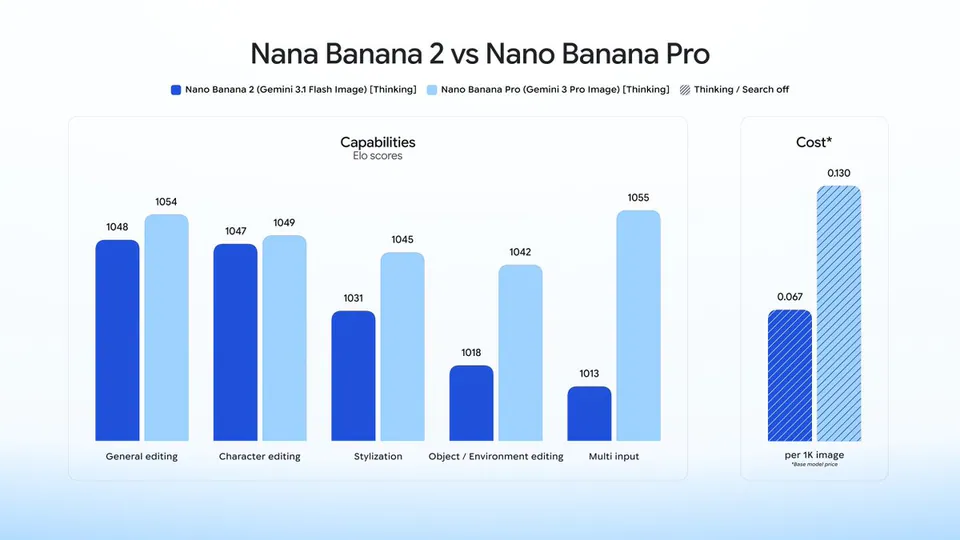
This update signals a transition from aesthetic illustration to industrial utility. While Nano Banana 2 brought high-quality visuals to faster inference (the process of running a trained model), the Pro model focuses on physical realism. The model's spatial accuracy was precise enough to 3D-print a functional object directly from a generated design.
You can use Nano Banana Pro for workflows requiring locked-in brand consistency across logos, typography, and environmental mockups. The model is currently available for enterprise users through Google Cloud and for prototyping in Google AI Studio, where it supports 4K output and advanced multi-image reference blending.
Beyond generating high-fidelity visuals, we wanted to test the limits of what Nano Banana Pro can do. We worked with design partners Porto Rocha to build out a hypothetical brand called YOYOYO to see how the model would handle the task. Here’s what we found:
🎨Brand consistency: Across logos, colors, and typography, the model maintained a strict, cohesive brand identity (even for wildly diverse concepts)
🛍️Environmental realism: We asked to see the products in storefront and studio mockups. It nailed accurate lighting, shadows, and physical proportions - even when upscaled for massive retail displays
🪀Spatial accuracy: We tested spatial volumes for physical packaging. The generated proportions were so precise that we were able to 3D-print the functional yo-yo
How have you been pushing the limits of Nano Banana Pro? Let us know in the replies below!
Google's Nano Banana Pro is an advanced AI image generation model, also known as Gemini 3 Pro Image. It is designed for professional creative workflows that require high-fidelity visuals, precise text rendering, and complex spatial understanding. The model excels at maintaining identity across multiple images and generating studio-quality mockups for commercial and industrial design.
The model uses advanced reference blending to maintain a strict, cohesive brand identity across diverse creative concepts. In testing with design partners, it successfully preserved specific logos, color palettes, and typography styles across various assets. This capability allows designers to generate infinite variations of a brand while ensuring the core visual identity remains locked in and recognizable.
Yes, Nano Banana Pro demonstrates high spatial accuracy that translates to physical manufacturing. During a collaborative test, the model generated packaging and product designs with such precise proportions and volumes that researchers were able to 3D-print a functional physical yo-yo directly from the output. This suggests the model understands physical dimensions and spatial volumes beyond simple 2D patterns.
Nano Banana Pro is available for enterprise customers through Google Cloud and for developers and creators via Google AI Studio. It is positioned as a professional-tier tool compared to the faster Nano Banana 2 model. Users can access it to generate 4K resolution images and utilize creative controls like blending up to 14 different reference images.
While Nano Banana 2 focuses on bringing high-quality image generation to faster inference speeds—the process of running a trained model—Nano Banana Pro is built for professional-grade precision. The Pro model offers superior spatial understanding, 4K output, and more extensive creative controls. It is specifically optimized for tasks like accurate text rendering, complex brand identity management, and physical product prototyping.
Every HeadsUpAI update is written based on its original source and reviewed before it's published. Read our editorial standards →