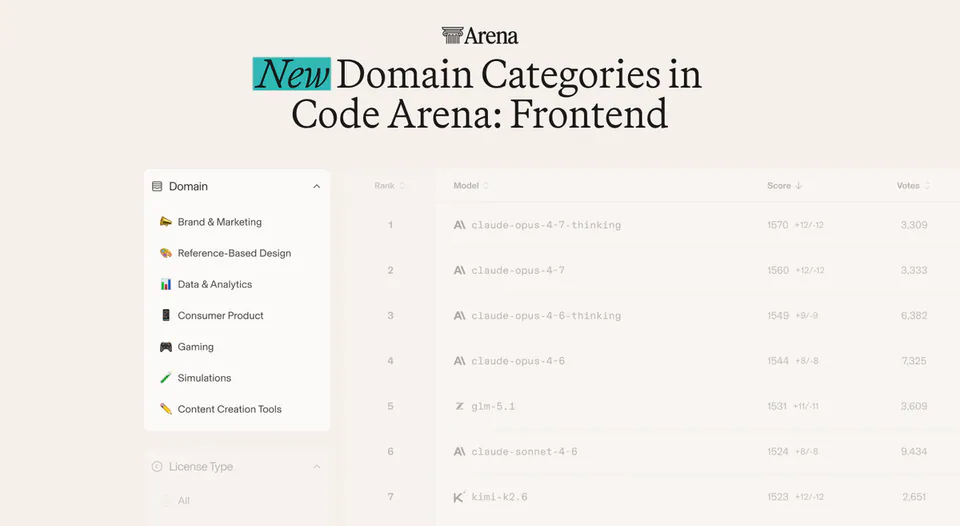
Where is AI-assisted web development heading? We've added new categories to Code Arena: Frontend, covering 7 domains across agentic web development. Learn about the ML methodology behind it, what the shifting data tells us about how people are actually using AI to build for the web, and which models are quietly excelling in specific niches. 0:00 What sparked the new 7 categories? 0:34 The classical ML approach: building a taxonomy from scratch 2:06 Clustering prompts at scale 2:19 Prototype extraction: using LLMs to name and label clusters 3:26 Why raw embeddings fail: language bias and multi-angle prompts 4:07 Breaking down user intent: what to build, style, components 5:09 From clusters to categories: the key research decision 6:43 Optimization goal #1: Coverage — how much of the data is represented? 7:12 Optimization goal #2: Boundary clarity — keeping definitions tight 8:19 The iterative refinement loop: human-in-the-loop + LLM polish 9:38 Measuring coverage (aiming for 80%+) and sampling the long tail 10:09 Optimization goal #3: Interpretability — titles that make intuitive sense 10:20 How available tools (web search, screenshots) shape the final categories 12:07 How prompt category distribution has shifted over time 14:40 Growing categories: brand/marketing sites and consumer products 14:41 Model-specific strengths: GPT-5.5 and Gemma-4-31b 15:09 Radar plots as a practical model-selection tool 16:11 Combining domain rankings with price/speed Pareto curves 16:52 Predictions: what new categories are coming next?