HeadsUpAI

Arena.ai Launches Task Specific Leaderboards to Map Frontend Coding Strengths

· Updated

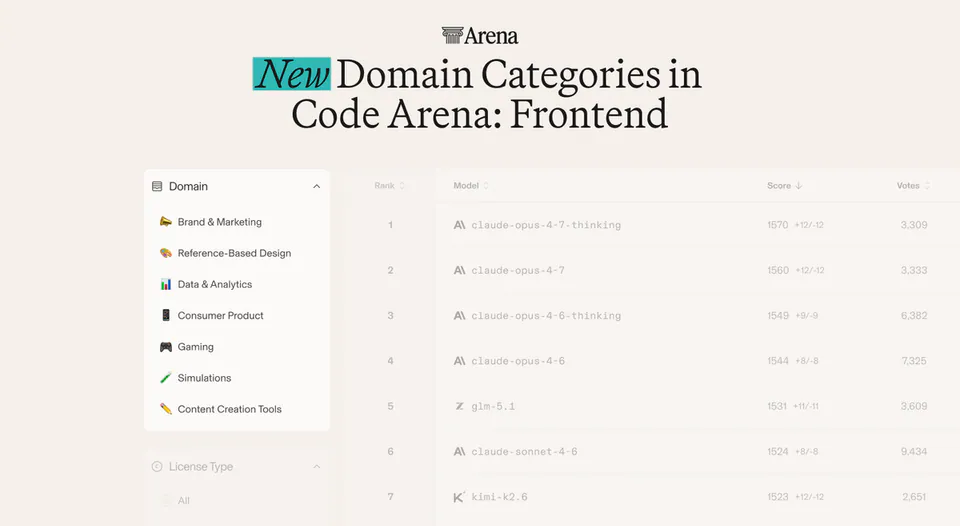
Arena.ai, a community-driven platform for blind AI model evaluation, launched seven domain-specific leaderboards for its Code Arena frontend benchmark. After analyzing 250,000 user prompts, the platform identified distinct categories including brand marketing, gaming, and data analytics. This shift moves beyond simple code generation to evaluating complex, product-oriented development tasks.
Evaluation categories
7 domains
Analysis sample size
250,000 prompts
Most common category
Reference-Based Design (29%)
Specialized category share
Simulations (15.3%)
Top proprietary models
Claude Opus 4.7 Thinking, GPT-5.5 High, Muse-Spark
Top open-source models
GLM-5.1, Kimi-K2.6, Gemma-4-31B

Aggregate scores often obscure a model's true utility for specific engineering projects. While Anthropic's Claude models show broad dominance, the new views reveal specialized expertise. For instance, GPT-5.5 leads in interactive simulations and gaming logic, while Meta's Muse-Spark excels in practical consumer product and marketing site construction.

Filter the Code Arena leaderboard by task type to select the most effective model for your project requirements. These views also track how open-source models like Google's Gemma 4 compete in specialized domains like consumer platforms. The updated leaderboards are live on the Arena website, providing a granular map for agentic coding decisions.


Arena.ai
Arena.ai
@arena
X

Introducing 7 new leaderboard views for frontend output in Code Arena. Aggregate leaderboards don’t tell the full story. "Best frontend coding model" depends on what you're building, so we built leaderboards that show exactly that. After analyzing 250,000+ Code Arena prompts, we identified the major frontend web development task categories: - Brand & Marketing - Reference-Based Design - Data & Analytics - Consumer Product - Gaming - Simulations - Content Creation Tools With this release, @AnthropicAI is a big winner as it has at least 1 model in top 4 spots across all 7 categories. But there’s more to the story in the margins. Dig into the thread to see exactly which models are currently on top of each domain.

12retweets80likes
View on X

Still wondering? A few quick answers below.

Arena.ai introduced seven specific categories for its frontend coding leaderboard: Brand and Marketing, Reference-Based Design, Data and Analytics, Consumer Product, Gaming, Simulations, and Content Creation Tools. These categories were identified by clustering over 250,000 user prompts to better reflect the diverse types of web applications developers actually build using AI models.

While Anthropic models like Claude Opus 4.7 Thinking show broad strength across all categories, other models have specific advantages. GPT-5.5 High is particularly strong in interactive tasks like simulations and gaming. Meta Muse-Spark excels in practical product-building scenarios, such as e-commerce platforms and marketing websites, showing that the best model depends on the specific task.

Arena.ai used clustering analysis on a dataset of 250,000 filtered prompts collected over five months. The taxonomy was refined based on interpretability, coverage, and statistical robustness. This allows the platform to tag prompts with multiple labels, acknowledging that real-world web development tasks often overlap, such as a dashboard that requires both data analytics and reference-based design.

Yes, the leaderboards are built on community-driven evaluations of real-world prompts. The platform analyzed a massive dataset of user interactions to ensure the categories represent actual developer needs. This methodology moves beyond simple code completion to measure how models handle multi-file React applications, tool use, and product-oriented development under realistic conditions.

Reference-Based Design is the most common category in Code Arena, accounting for roughly 29 percent of prompts. It includes requests for websites or applications inspired by known products, layouts, or visual styles. An example is asking a model to build a Windows 95 desktop with draggable windows, a start menu, and proper z-index stacking for icons.

Share this update