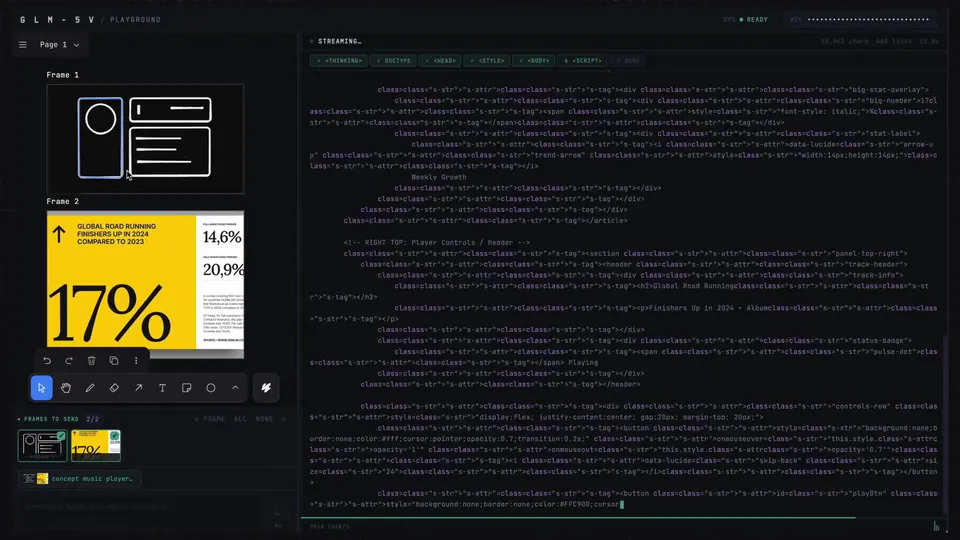
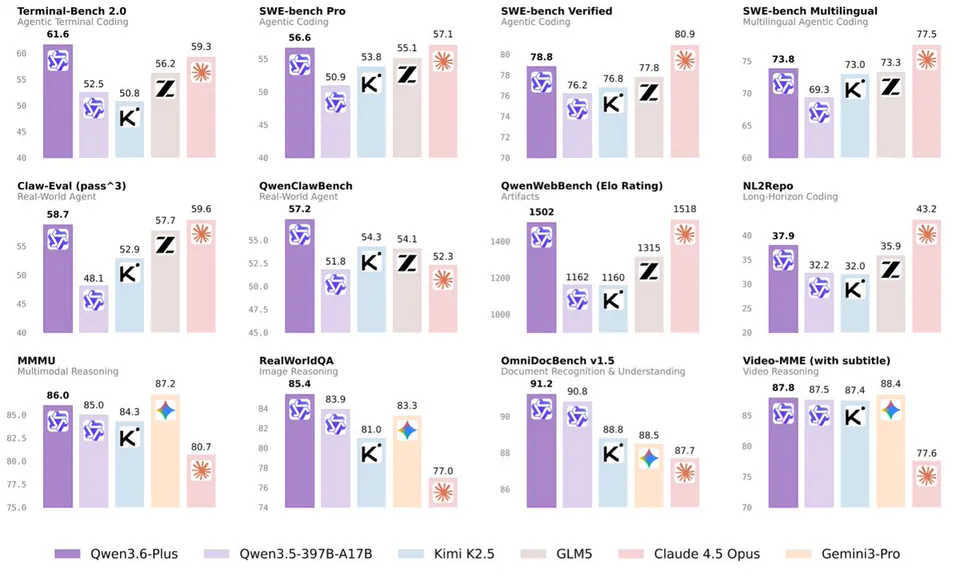
GLM-5V-Turbo Tech Report: Toward a Native Foundation Model for Multimodal Agents This report summarizes the main improvements behind GLM-5V-Turbo across model design, multimodal training, reinforcement learning, toolchain expansion, and integration with agent frameworks. These developments lead to strong performance in multimodal coding, visual tool use, and framework-based agentic tasks. https://t.co/5mCu2VHZlI
Zhipu AI Details GLM-5V-Turbo Architecture for Native Multimodal Agents
Zhipu AI, the lab behind the GLM model series, released a technical report for GLM-5V-Turbo, a multimodal foundation model (AI that processes text, images, and video together) built for agents. The report details
CogViT, a vision encoder (a component that translates images into data) and a new training architecture called Multimodal Multi-Token Prediction.- Vision encoder
- CogViT (SigLIP2 and DINOv3 distillation)
- Training architecture
- Multimodal Multi-Token Prediction
- Reinforcement learning scope
- 30+ task categories
- Availability
- Z.ai developer platform (Early access)
- Training focus
- Multimodal code datasets
This update addresses the gap between visual perception and agentic reasoning. While many models use vision as an interface, the GLM-5V-Turbo launch integrated perception directly into the planning loop. This shift is critical for GLM-5 agentic engineering, where an AI must navigate software interfaces without losing fidelity.
You can use the model for visual tool use, GUI navigation, and multimodal coding. Zhipu AI is accepting applications for early experimentation from users on its coding plans. The model builds on GLM-5 infrastructure stabilization and is available via the Z.ai developer platform for building agentic workflows.
Z.ai
@Zai_org
129retweets901likes
View on XStill wondering? A few quick answers below.
GLM-5V-Turbo is a multimodal foundation model developed by Zhipu AI specifically for autonomous agents. Unlike models that use vision as an external interface, it integrates multimodal perception as a core component of reasoning and planning. This allows the model to interpret and act across diverse contexts like graphical user interfaces, web pages, and complex documents.
The CogViT vision encoder uses a dual-teacher distillation process to improve image understanding. It combines SigLIP2 for semantic recognition and DINOv3 for capturing fine-grained textures and details. The training involves a two-stage recipe using masked modeling and contrastive pretraining, with specific attention mechanisms to ensure stability when scaling the model to larger datasets.
Multimodal Multi-Token Prediction is a training architecture that improves how the model processes visual data. It uses a shared image token to pass information into the prediction head, which removes the need to carry heavy visual embeddings through every stage of the pipeline. This approach increases training stability and efficiency when the model handles complex multimodal inputs.
The model underwent joint reinforcement learning across more than 30 task categories to improve its performance as an agent. Zhipu AI rebuilt its infrastructure to support full-pipeline asynchrony and fine-grained memory management. This allows the model to handle variable-length visual inputs and perform consistently across multimodal coding, visual tool use, and framework-based agentic tasks.
Developers and users on Zhipu AI coding plans can apply for early experimentation with GLM-5V-Turbo through an official application form. The model is designed for integration with agent frameworks and is available via the Z.ai developer platform. It is currently positioned as a tool for building agents that require native multimodal perception and reasoning capabilities.