
HeadsUpAI

Warp Launches Open Weight Model Routing to Optimize Agentic Development Costs

· Updated

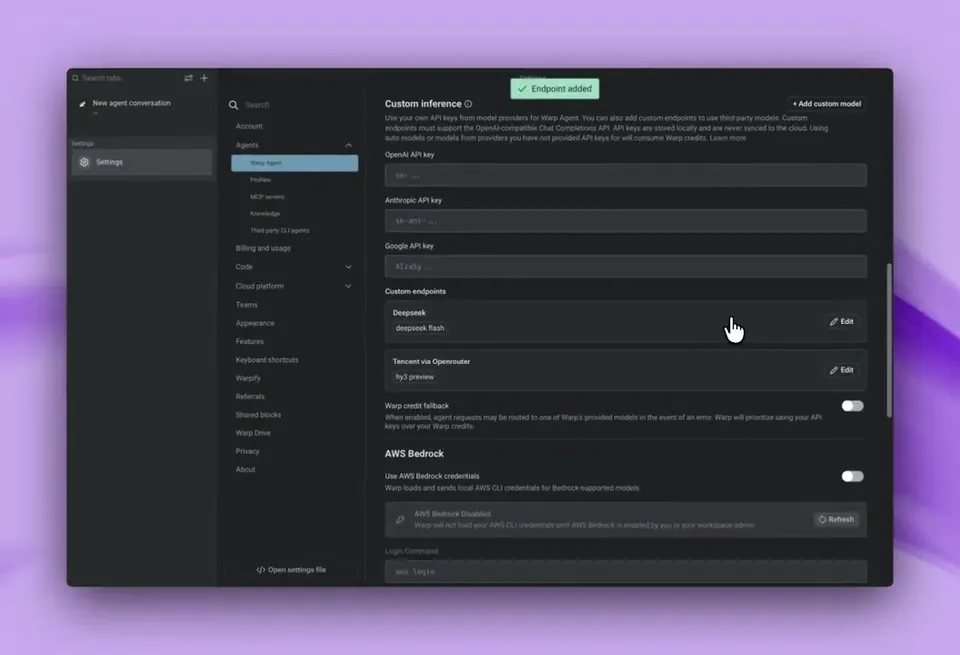
Warp, an agentic development environment combining a terminal and code editor, launched an auto (open-weights) model routing feature. This setting automatically directs agent tasks to frontier-level open-weight models (models whose trained parameters are publicly released) based on task complexity. It follows the platform's recent Warp agentic rebrand.

Agentic workflows involve iterative loops and high token consumption, making expensive closed models inefficient for every task. This update targets cost-effectiveness by utilizing frontier-level open models when complexity allows. It offers a high-performance engine for the Warp agentic feedback loops and autonomous tasks the platform now supports.

Enable the new routing mode within Warp agent settings to reduce overhead without sacrificing reasoning quality. The feature is available now, providing a middle ground between standard performance and the high-end genius mode. It complements the existing Warp's GPT-5.5 integration by offering a cheaper alternative for routine operations.

Warp
Warp
@warpdotdev
X

Warp's agent now has an `auto (open-weights)` model. This will route you to frontier-level open weight models based on the complexity of your task. High performance at a reduced token cost compared to "genius" mode. https://t.co/VNdOaP0uvN

6retweets48likes
View on X
Still wondering? A few quick answers below.

The auto (open-weights) model is a new routing setting for Warp's AI agent that directs development tasks to high-performing open-weight models. These are models whose trained parameters are publicly available for use. This setting provides frontier-level intelligence for terminal workflows while optimizing for lower inference costs compared to using the platform's high-end genius mode.

Warp's agent uses intelligent routing to analyze the complexity of a specific terminal command or development task. Based on that analysis, it automatically selects the most appropriate open-weight model to execute the request. This ensures that simpler tasks do not consume expensive frontier model tokens, while complex reasoning still receives the necessary computational power to complete the task.

The auto (open-weights) model is designed to offer high performance at a significantly reduced token cost compared to the platform's top-tier genius mode. While genius mode typically uses the most powerful models available, the open-weights option leverages frontier-level open models to provide a more economical alternative for agentic workflows while maintaining the performance required for complex tasks.

The auto (open-weights) model is currently available as a selectable option within the Warp agent settings. Developers can switch to this mode to manage their token usage more effectively during multi-step agentic tasks and terminal commands. It is part of Warp's broader transition into a unified agentic development environment designed to orchestrate autonomous coding agents and workflows.

Share this update