HeadsUpAI

OpenClaw Slashes Model Latency and Hardens Windows Installs for Self Hosted AI

OpenClaw, an open-source self-hosted AI assistant, released v2026.5.22 to address performance bottlenecks. The update introduces a pre-warming mechanism for provider authentication that allows the platform to short-circuit discovery paths. This optimization drops the latency for listing available models from roughly 20 seconds to just 5 milliseconds.
Model listing latency
5ms
Context window
1M tokens
New plugin source
Discord voice
Dependency management
npm shrinkwrap
Supported platforms
Windows, macOS, Linux, and others

This performance leap addresses a core friction point in OpenClaw's self-hosted infrastructure hardening, where managing multiple providers often results in a sluggish experience. By hardening the Windows installation path with portable environments, the platform also targets the reliability gaps that frequently stall OpenClaw's autonomous web navigation reliability on consumer hardware.

You can now capture meeting transcripts using a new plugin that supports Discord voice. The update also secures the supply chain by shipping npm packages with locked dependencies to prevent version drift. OpenClaw is open-source, with native support for 1M context windows now migrated to the latest Claude models.


OpenClaw🦞
OpenClaw🦞
@openclaw
X

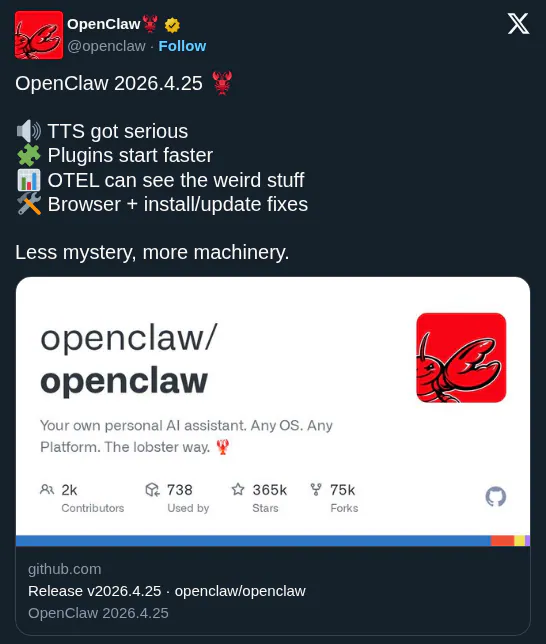
OpenClaw 2026.5.22 is live ⚡ Gateway/model startup paths got leaner 🧠 /models drops to ~5ms 🔒 npm packages ship locked deps 🪟 Windows install/update paths hardened Less waiting, fewer surprises. https://t.co/k6tetMaS0b

23retweets198likes
View on X

Still wondering? A few quick answers below.

OpenClaw achieved a significant performance boost by pre-warming the provider authentication state at startup. This optimization allows the system to short-circuit the discovery process for external model providers and command-line interfaces. As a result, the response time for listing available models dropped from approximately 20 seconds to just 5 milliseconds.

The v2026.5.22 update hardens Windows support by using portable versions of Git and Node.js to ensure a consistent environment. It also introduces safer shims for package managers and an automatic rollback feature. If a git-backed update fails during the installation or build phase, the system now automatically reverts to the previous stable checkout.

Yes, the latest release adds a dedicated meeting notes plugin and a software development kit provider contract. This allows the assistant to capture and import transcripts from external sources. Discord voice is the first live source supported for this feature, and users can access these notes through a read-only command-line interface.

To prevent performance degradation when loading long conversation lists, OpenClaw added search functionality and pagination to the chat session picker. This bounded loading approach ensures the interface remains responsive while still allowing users to reach older chats. The search bar is now integrated directly into the session selector for a cleaner layout.

OpenClaw is an open-source, self-hosted AI assistant platform that users can run on their own hardware. The project is hosted on GitHub, where the community contributes to its development. The latest version includes security enhancements like locked dependency graphs for npm packages to ensure that all self-hosted installations use verified and consistent software versions.

Share this update