HeadsUpAI

OpenClaw Adds Discord Voice Mobility and Security Linting for Self-Hosted Agents

OpenClaw, an open-source self-hosted AI assistant that operates across messaging platforms, released version 2026.5.20. The update introduces Discord voice mobility, allowing AI sessions to follow configured users as they move between voice channels while maintaining multi-user handoff. It also adds a security linting tool to detect plaintext secrets in configuration files.

This release addresses the friction of self-hosting by automating security best practices. By warning users about exposed API keys, the platform reduces the risk of accidental credential leaks. The addition of OpenClaw's headless xAI authentication via device-code OAuth (a protocol for authorizing devices without a browser) further simplifies deployment on remote servers.

Real-time voice sessions now automatically ingest profile context from identity and soul files to preserve agent persona. The update also resolves Windows installation freezes and ensures managed updates use the correct Node.js binaries. Version 2026.5.20 is available now as a free update for all self-hosted OpenClaw instances.

OpenClaw🦞
OpenClaw🦞
@openclaw
X

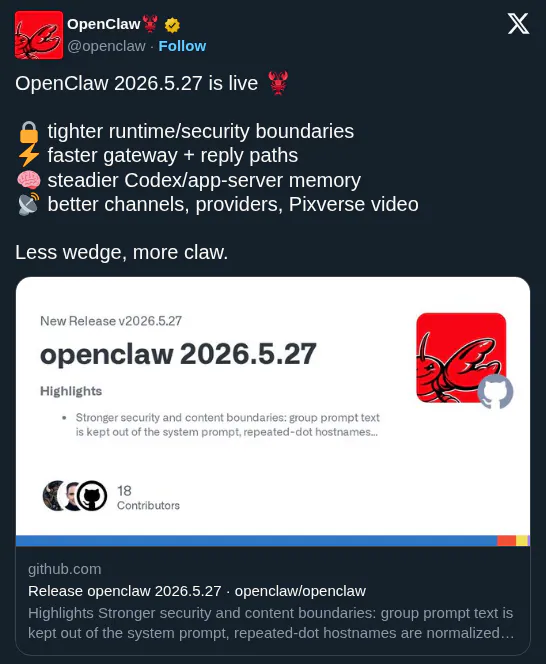
OpenClaw 2026.5.20 🦞 🎙️ Discord voice follows you 🔐 Doctor catches plaintext secrets 🧭 Model status explains surprises 🪟 Windows install gets unstuck Still into boring fixes. https://t.co/VN10A3LkU0

85retweets755likes
View on X

Still wondering? A few quick answers below.

OpenClaw is an open-source, self-hosted AI assistant designed to run on a user's own hardware. It functions across various messaging platforms like Discord and WhatsApp, allowing users to automate tasks such as emails, calendars, and home automation while maintaining full control over their data and the underlying model rules.

The Discord voice following capability allows an AI session to track specific users as they move between different voice channels. The system handles multi-user handoffs and performs allowed-channel checks to ensure the assistant only enters authorized spaces. It also preserves Distributed Audio Video Encryption recovery to maintain secure communication during these transitions.

The Doctor utility is a diagnostic tool that now includes a security linting feature to protect sensitive information. It scans the assistant's configuration files for plaintext secrets, such as API keys or sensitive provider headers. When it finds these exposed credentials, it issues a warning so users can clean up their configuration before a security breach occurs.

OpenClaw now supports device-code OAuth for xAI, which is specifically designed for headless or remote setups. This allows you to authorize the assistant without needing a local browser callback on the machine where it is running. You can complete the authorization process on a separate device, making remote server deployments much simpler.

Yes, OpenClaw is available for Windows and the latest update specifically addresses installation issues on that platform. It fixes a bug where the native installer would visibly freeze during the initial setup phase. The update also ensures that managed system updates consistently use the correct service binaries rather than silently switching between different Node.js installations.

Share this update