OpenAI Launches Workspace Agents for ChatGPT to Automate Multi-Step Team Workflows

OpenAIOpenAI

· Updated

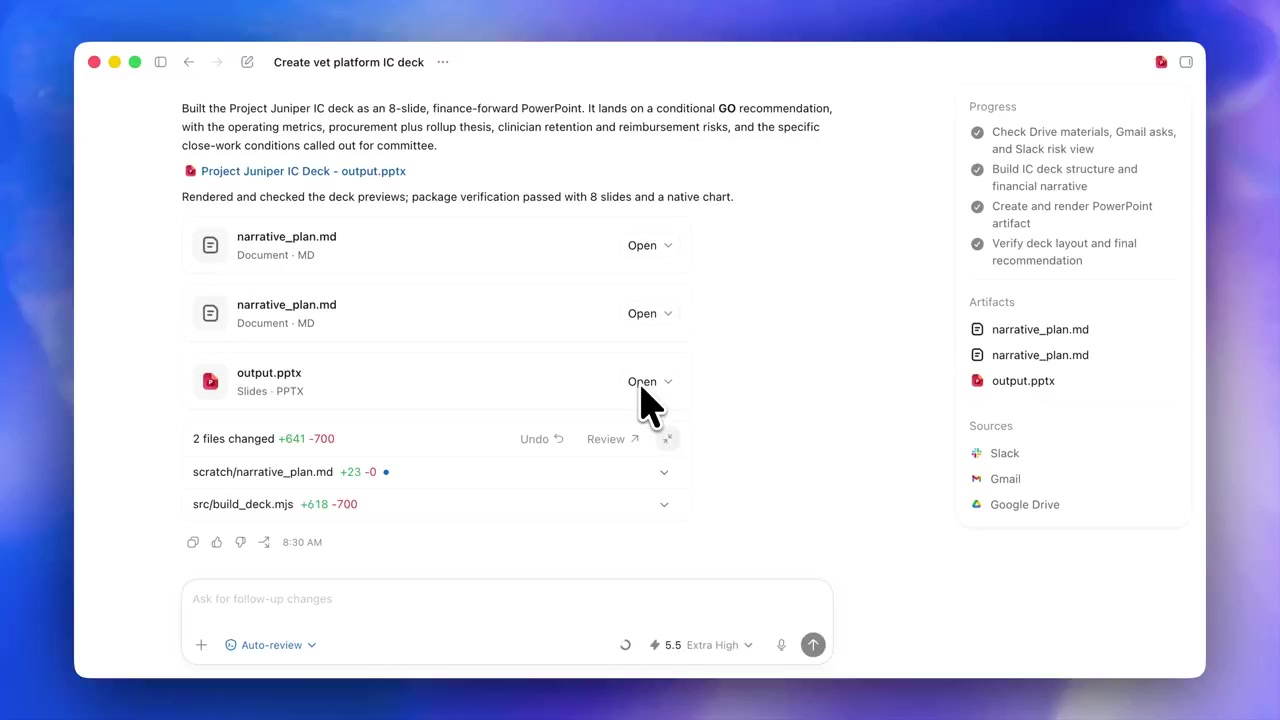
OpenAI released workspace agents in research preview for ChatGPT Business and Enterprise plans. These shared agents can execute long-running workflows across tools like Slack and Google Drive independently of user interaction. This shifts ChatGPT from a reactive assistant to a proactive automation layer that manages entire business processes.

OpenAI launched workspace agents in research preview for ChatGPT Business, Enterprise, and Edu plans. These shared AI systems handle complex, multi-step tasks and long-running workflows across an organization's software stack. Unlike standard assistants, these agents execute unattended workflows on schedules or in the background while users are away.
Availability
Research preview
Supported plans
ChatGPT Business, Enterprise, Edu, Teachers
Core integrations
Slack, Google Drive, Microsoft SharePoint, Linear
Execution modes
Background, Scheduled, On-demand
Admin controls
Audit logs, Permissions, Approval gates

This update marks a transition from conversational AI to agentic AI (autonomous systems that plan and execute multi-step goals) within the enterprise. It builds on the parallel subagent architecture and follows a push to standardize automated workflows across teams. Organizations can now deploy these systems at scale rather than relying on individual custom GPTs.

You can build agents that pull context from docs and chats to take approved actions like updating Linear issues. Admins manage these systems through a central console with audit logs and approval gates. The feature is available for ChatGPT Business, Enterprise, Edu, and Teachers subscribers.

OpenAI
OpenAI
@OpenAI
X

Introducing workspace agents in ChatGPT—shared agents that can handle complex tasks and long-running workflows across tools and teams. https://t.co/eHplfXCWlk

1.6kretweets17klikes
View on X

Still wondering? A few quick answers below.

Workspace agents are shared AI systems in ChatGPT designed to automate entire multi-step workflows across a team. Unlike standard chatbots that respond to individual prompts, these agents can pull context from various enterprise tools, take actions like updating tickets or sending messages, and continue running in the background or on a set schedule without constant human direction.

Workspace agents are currently available in a research preview for users on ChatGPT Business, Enterprise, Edu, and Teachers plans. This rollout allows organizations to test the autonomous capabilities of these agents within their specific environments. Access is managed through the organization's workspace, where admins can control who has the ability to build and deploy them.

These agents use integrations to gather information and execute tasks across different platforms. For example, an agent can monitor a Slack thread to understand a request, pull relevant data from a document in Google Drive, and then update a task in Linear. They operate across these tools to complete end-to-end processes that previously required manual coordination.

OpenAI provides centralized management for admins to oversee agent activity. This includes role-based access control to determine who can build agents and which tools they can access. Admins can also review detailed audit logs of agent actions and implement approval gates, which require a human to verify and sign off on sensitive actions before the agent proceeds.

Yes, workspace agents are designed to handle long-running workflows and recurring tasks independently. They can be set to run on specific schedules or continue working in the background after a user initiates a process. This allows them to handle time-consuming work like summarizing support requests, reviewing leads, or generating reports without requiring the user to stay active.

Every HeadsUpAI update is written based on its original source and reviewed before it's published. Read our editorial standards →

Share this update