AWS Launches Managed Agent Harness to Automate Infrastructure for AI Agents

Amazon Web ServicesAmazon Web Services

· Updated

AWS introduced a managed agent harness for Amazon Bedrock AgentCore that allows developers to launch working AI agents in three API calls without writing orchestration code. By handling sandboxing, session persistence, and security, the platform reduces the time required to move from an initial agent prototype to a production-ready deployment.

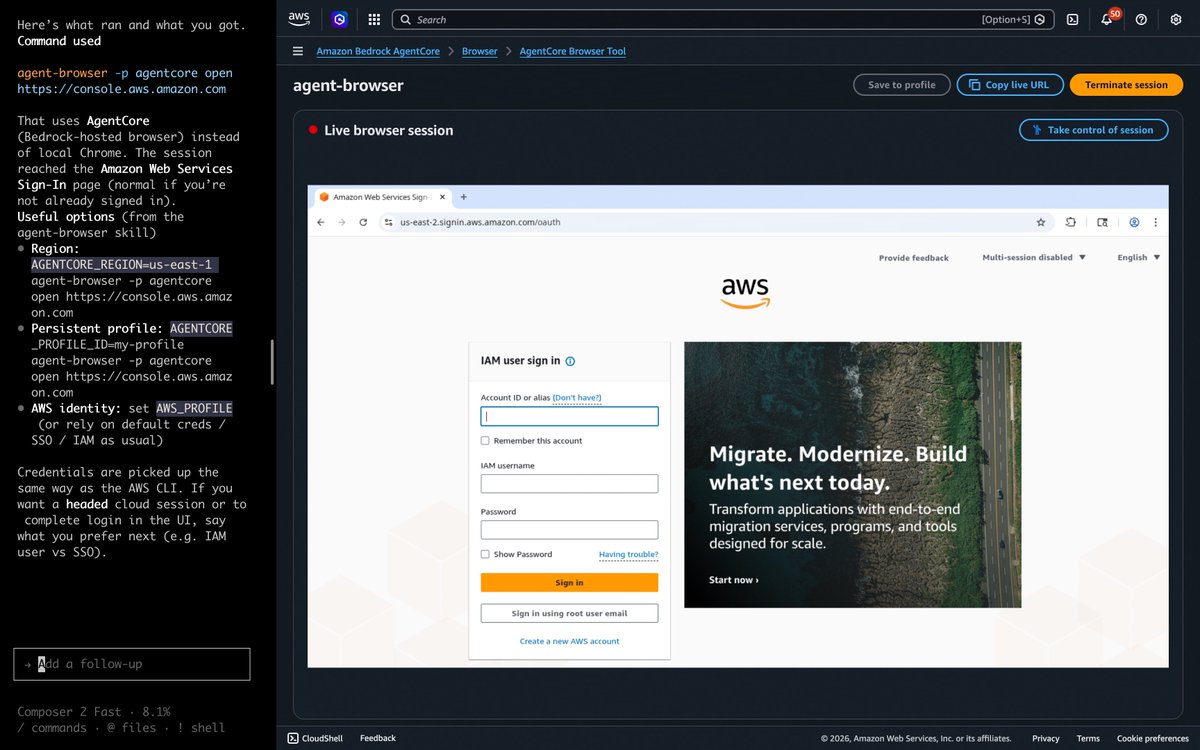
AWS launched a managed agent harness in preview for Amazon Bedrock AgentCore, a platform for building and operating AI agents. The harness allows you to configure an agent's model, tools, and instructions via API, automatically handling the agent loop (the iterative cycle of reasoning and action).
Managed harness setup
3 API calls
Orchestration framework
Strands Agents (open source)
CLI availability
General availability with Cloud Development Kit support
Persistent state
Durable agent filesystem (General Availability)
Preview regions
Oregon, N. Virginia, Sydney, Frankfurt
Coding assistant support
Claude Code, Codex, Cursor, Kiro

This update addresses the "infrastructure tax" that typically delays agent development. It mirrors the shift toward standardized production infrastructure seen across the industry, allowing teams to focus on agent logic. It builds on automated testing frameworks to create a complete environment for reliable agentic engineering.

You can now use the AgentCore CLI to prototype and deploy agents using Infrastructure as Code from your terminal. The managed harness is in preview in four regions, while the persistent filesystem is generally available. Curated best practices for coding assistants like Claude Code and Cursor arrive late April.

Still wondering? A few quick answers below.

The managed agent harness is a configuration-driven environment that automates the infrastructure needed to run AI agents. It handles the orchestration loop, which manages how an agent calls models and uses tools, without requiring developers to write custom backend code. This allows teams to launch a working agent prototype using just three API calls.

The persistent agent filesystem provides durable storage that allows AI agents to save their state across different sessions. This capability is essential for human-in-the-loop workflows, where an agent might need to pause a task to wait for human approval or input and then resume exactly where it left off without losing its progress or context.

The managed agent harness is currently available in preview in four AWS regions: US West (Oregon), US East (N. Virginia), Asia Pacific (Sydney), and Europe (Frankfurt). Other features, including the AgentCore CLI and the persistent agent filesystem, are generally available in all AWS commercial regions where the Amazon Bedrock AgentCore service is currently offered.

There are no additional charges for using the AgentCore CLI, the managed agent harness, or the upcoming coding assistant skills. Users only pay for the underlying AWS resources consumed during the agent's operation, such as model inference through Amazon Bedrock or compute and storage resources. This consumption-based model allows for cost-effective prototyping and scaling.

AWS is releasing pre-built skills that provide curated best practices and patterns for agent development. These skills are already built into the Kiro IDE as a native capability. Plugins for other popular coding assistants, including Claude Code, Codex, and Cursor, are scheduled to be available by the end of April to help developers write better agent logic.

Every HeadsUpAI update is written based on its original source and reviewed before it's published. Read our editorial standards →

Share this update