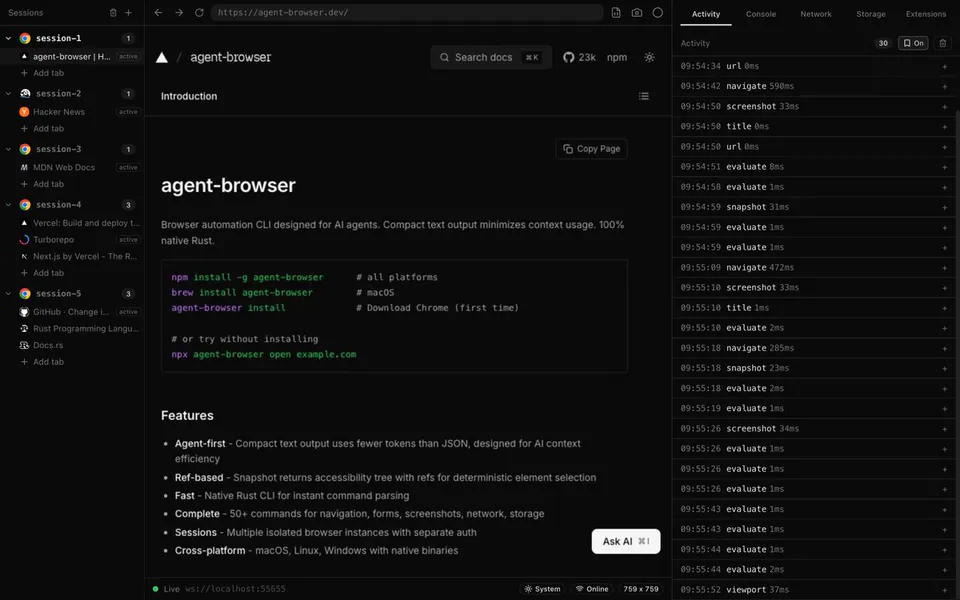
agent-browser v0.27 Big day for agents and browsers → React introspection: react tree, react inspect, react renders, react suspense for component trees, props/hooks/state, render profiling, and Suspense analysis → Web Vitals: vitals command reports LCP, CLS, TTFB, FCP, INP + React hydration phases → SPA navigation: pushstate for client-side nav without full page loads → Init scripts: --init-script and --enable flags to register scripts before first navigation → Network route filtering by resource type → cURL cookie import (JSON, cURL, Cookie-header formats) → Dashboard works behind reverse proxies Thanks to @thoma33 @andrewqu @shaper for being part of this release! https://t.co/UefAqZ5ShH
Vercel Labs Gives AI Agents Deep React Introspection and Performance Auditing Powers
Vercel Labs, the experimental arm of the frontend cloud platform, released agent-browser v0.27 with native React introspection. This allows AI agents to inspect the React Fiber tree—the internal representation of component state—and profile render counts. The update also adds a
vitals command to report Core Web Vitals (standardized site speed metrics).This shift moves browser-based AI agents from simple agent-browser natural language automation into specialized technical auditors. While previous versions focused on Vercel's agent-browser dashboard, agents can now diagnose framework-specific bugs invisible in the DOM. Vercel is providing the "X-ray vision" required for autonomous performance engineering and deep-state debugging.
You can now use react tree and react inspect to let agents debug state-related issues or vitals to automate performance audits. The release also adds pushstate for SPA navigation and cURL cookie imports. The tool is open-source and available via npm as a CLI.
Chris Tate
@ctatedev
18retweets309likes
View on XStill wondering? A few quick answers below.
Agent-browser is a command-line interface developed by Vercel Labs that provides browser automation specifically for AI agents. It allows autonomous systems to interact with websites by navigating pages, clicking elements, and filling forms. Unlike standard automation tools, it is optimized for agentic workflows, focusing on semantic understanding and efficient context management for large language models.
The v0.27 update introduces first-class React DevTools integration, allowing agents to see the internal component tree. Using commands like react tree and react inspect, agents can view props, hooks, and state for specific components. It also includes render profiling to track mount counts and change details, giving agents deep visibility into a web application framework logic.
The new vitals command in agent-browser v0.27 reports Core Web Vitals including Largest Contentful Paint, Cumulative Layout Shift, and Time to First Byte. It also tracks First Contentful Paint and Interaction to Next Paint. Beyond these standard metrics, the tool provides data on React hydration phases, helping agents identify performance bottlenecks during the initial page load.
Users can import cookies in bulk using the cookies set command with the curl flag. This feature automatically detects and processes multiple formats, including JSON, standard cURL commands, and raw Cookie-header strings. This allows developers to quickly provide AI agents with existing session data or authentication states required to access protected areas of a web application.
Yes, agent-browser is an open-source project maintained by Vercel Labs on GitHub. It is available as a public repository where developers can contribute to its development or report issues. The tool can be installed via npm and used as a standalone CLI or integrated into larger AI agent frameworks to provide them with native web browsing capabilities.