HeadsUpAI

Fireworks AI Uses Delta Compression to Reduce Frontier RL Training Costs

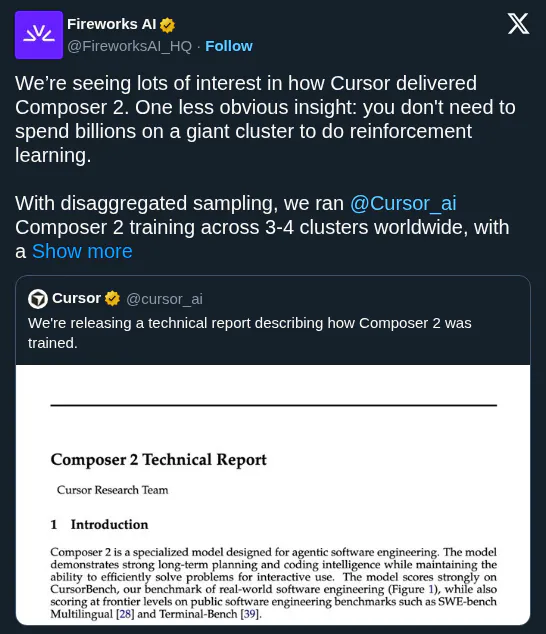
Fireworks AI, an inference platform for fast model serving, detailed a disaggregated reinforcement learning (RL) architecture that removes the need for co-located GPU clusters. The system uses delta-compressed updates to sync the trainer with the rollout fleet, shipping only the 2% of weights that change between checkpoints.
Weight sparsity
98% or more
Average delta size
20.3 GiB
Transfer volume reduction
94%
Weight swap time
Under 1 minute
Deployment options
Managed, SDK, and Bring-your-own-trainer

This shift challenges the narrative that restricts frontier-scale RL to elite labs with contiguous hardware. By exploiting weight sparsity, the architecture makes cross-region synchronization practical over standard network links. This approach powered Cursor's Composer 2 training run, proving that fragmented capacity can be unified into a single elastic pool.

You can access these capabilities through the Fireworks Training SDK, which supports managed RL and bring-your-own-trainer setups. The platform includes specialized APIs for weight-update signaling and MoE sampling to maintain alignment. This infrastructure is now available for teams building custom reasoning agents on models like Kimi K2.6.

Still wondering? A few quick answers below.

Delta compression is a technique that identifies the small fraction of model weights—typically less than 2%—that change between consecutive reinforcement learning checkpoints. Instead of shipping a full 1TB model across the network, Fireworks AI only transmits these changed bits. This allows training and inference clusters to stay synchronized over standard network links without expensive, co-located hardware.

Asynchronous RL, or pipeline RL, allows the training cluster and the rollout fleet to operate simultaneously rather than waiting for each other. While the trainer updates parameters, the rollout fleet generates data using a slightly older policy. This trade-off accepts a small amount of policy staleness to ensure that expensive GPU resources remain fully utilized and never sit idle.

Yes, Fireworks AI supports a bring-your-own-trainer setup where you keep your training cluster on your existing infrastructure. You upload checkpoints to shared storage, and Fireworks handles the rollout serving and weight-update orchestration. This is managed through a specialized API that signals when new checkpoints are available and provides status reporting for the update progress across global clusters.

The traditional mega-cluster requirement assumed that shipping massive 1TB checkpoints required trainer and inference nodes to share a single high-speed RDMA fabric. By reducing the transfer volume by 94% through delta compression, Fireworks AI makes it practical to use fragmented GPU capacity scattered across different regions. This allows teams to scale their rollout fleets elastically without contiguous hardware.

The Fireworks Training SDK is designed to support frontier-scale models, including those with trillion-parameter architectures. It has been used in production for major runs like Cursor's Composer 2 and supports high-performance open-weight models such as Kimi K2.6 and Qwen 3.5. The platform provides the necessary infrastructure for full-parameter fine-tuning and reinforcement learning with large context windows.

Share this update