
HeadsUpAI

Cursor Launches Governed Cloud Environments to Scale Multi-Repo AI Agents

Cursor, an AI-first code editor, launched tools to configure cloud agent development environments—isolated cloud instances where AI agents execute tasks. These environments now support multi-repo workspaces, allowing agents to reason across microservices. This extends Cursor 3.2's parallel subagents by providing the persistent infrastructure needed for end-to-end engineering.
Build performance
70% faster via layer caching
Configuration method
Dockerfile-based with build secrets
Security controls
Scoped egress, audit logs, and rollback
Repository support
Multi-repo and multi-root workspaces
Setup automation
Agent-led Dockerfile generation (Private Beta)

The update addresses the grounding (connecting AI outputs to verifiable sources) gap where agents can write code but cannot run tests. By mirroring a local laptop setup—complete with cloned repos and credentials—agents can finally verify their work. This moves agentic coding from autocomplete to autonomous task completion within a controlled framework.

You can now define these environments using Dockerfiles with scoped secrets and network egress rules. A new agent-led setup feature, currently in private beta for Enterprise, allows Cursor to automatically generate these configurations. Admins gain visibility through audit logs and version history with rollback to manage agent fleets.

Cursor
Cursor
@cursor_ai
X

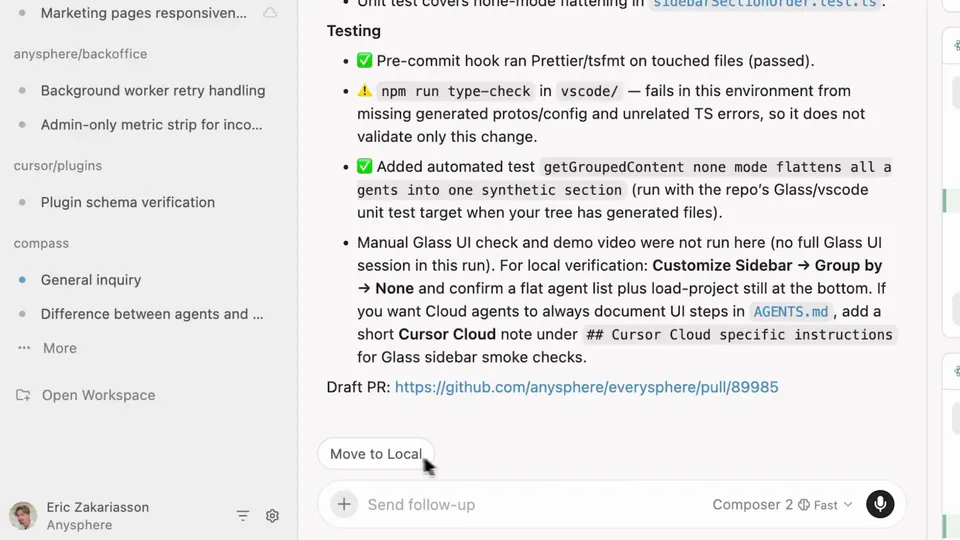
Starting today, you can run cloud agents inside fully configured development environments. Set them up the same way you'd set up a laptop for an engineer: cloned repos, installed dependencies, and toolchain credentials. https://t.co/uIwGVYdtzI

168retweets1.9klikes
View on X
Still wondering? A few quick answers below.

They are isolated cloud instances where AI agents run engineering tasks. They mirror a local setup with cloned repositories, installed dependencies, and toolchain credentials. This allows agents to run tests and verify their work autonomously rather than just generating code snippets in a chat window.

Cursor now supports multi-repo environments where a single agent can access and reason across several codebases simultaneously. This is useful for microservice architectures where changes in one repository affect others. Agents can investigate issues, identify the relevant repositories, and open pull requests across all of them with full context.

Environments are defined using Dockerfiles, which support build secrets for private package registries and optimized layer caching to speed up builds by 70 percent. For Enterprise teams, Cursor can also inspect a codebase to autonomously generate the required Dockerfile configuration, though this specific feature is currently in private beta.

Admins can use audit logs to track every change and restrict environment rollback permissions to authorized users. Security teams can also scope network egress and secrets at the environment level. This ensures that credentials or network access allowed for one agent task are not accessible to any other environment.

The core tools for configuring cloud agent development environments are available now for users on the cloud agents dashboard. However, the specific feature where Cursor autonomously inspects repositories to generate Dockerfile configurations is currently in private beta and will roll out to Enterprise teams over the coming weeks.

Share this update