HeadsUpAI

Anthropic Shares Best Practices for Running Claude Code at Enterprise Scale

Anthropic launched “Claude Code at scale,” a series on how its agentic coding tool handles multi-million-line monorepos. The update introduces the “harness,” a framework of five extension points—CLAUDE.md files, hooks, skills, plugins, and MCP servers—that determines performance more than the underlying model itself.

Traditional RAG often fails in large codebases because indices become stale. Anthropic argues for agentic search, where Claude Code traverses the live file system like an engineer. This approach mirrors OpenAI Codex’s parallel subagents by using isolated instances to map subsystems before editing.

You can optimize deployments by layering CLAUDE.md files and using LSP integrations for symbol-level navigation. Organizations should consider appointing an agent manager to centralize conventions. Claude Code is available for Team and Enterprise plans, with Claude Code multi-agent code review capabilities already in preview.

ClaudeDevs
ClaudeDevs
@ClaudeDevs
X

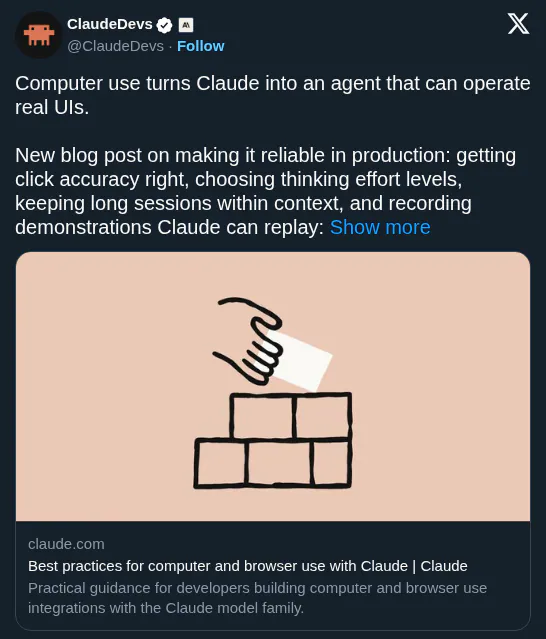
What are best practices for running Claude Code at scale? New blog post on what we've learned from teams running it across multi-million-line monorepos, decades-old legacy systems, and distributed microservices: https://t.co/rJUYlIUiTT

309retweets3.2klikes
View on X

Still wondering? A few quick answers below.

Claude Code uses agentic search to navigate codebases by traversing the file system, reading files, and using grep to find specific information in real time. Unlike traditional tools that rely on pre-built embedding indices which can become stale, this approach works directly from the live codebase on a developer's local machine to ensure accuracy.

The harness is a five-layer extension framework that determines how Claude Code performs in complex environments. It consists of CLAUDE.md files for context, hooks for automation, skills for specialized expertise, plugins for distribution, and Model Context Protocol servers for tool integration. This ecosystem is often more critical to performance than the underlying AI model itself.

Retrieval-augmented generation tools typically embed a codebase into a centralized index, which can fail at scale if the index does not update as fast as the engineering team commits code. Claude Code avoids this by using agentic search to explore the live codebase in real time, making it more accurate when working with frequently changing or distributed monorepos.

An agent manager is a designated role Anthropic recommends for enterprise teams using Claude Code at scale. This person is responsible for maintaining shared CLAUDE.md conventions, reviewing hooks and plugins, auditing skill libraries, and standardizing how different teams configure their agentic workflows. The role helps prevent configuration fragmentation across large engineering organizations.

Claude Code's enterprise-grade features, including multi-agent code review and team-wide harness configurations, are available on Anthropic's Team and Enterprise plans. Individual developers can still use Claude Code on personal plans, but features like centralized policy management, shared plugins, and organization-level hooks require a subscription that supports organizational admin controls.

Share this update