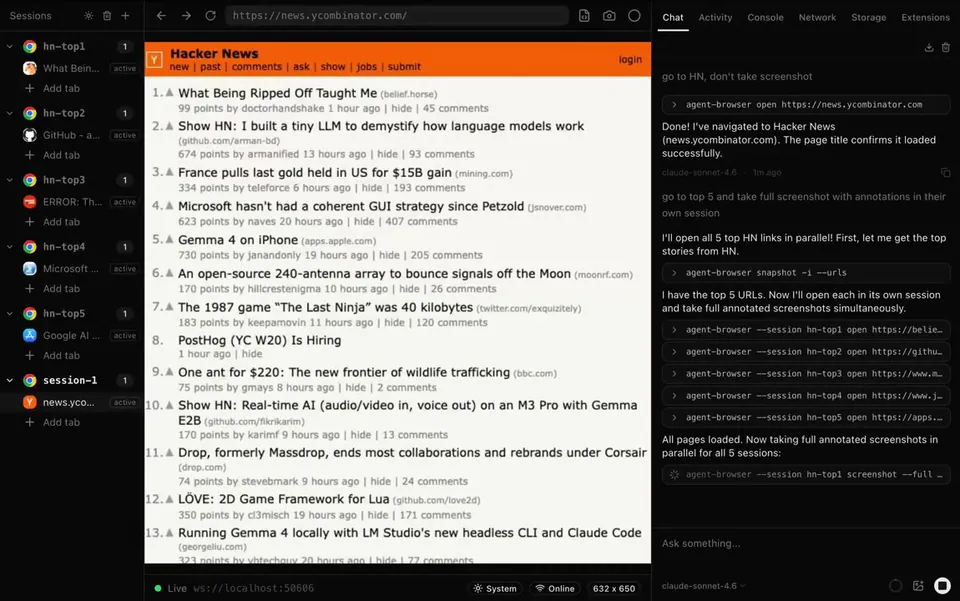
Terminal automation + e2e testing solved Now as simple as snapshot, click, type: – wterm renders terminal-in-html, every cell in the a11y tree – agent-browser automates pages via the a11y tree Here's opencode in one browser driving Claude Code in another https://t.co/kuuy9E78c2
Vercel Launches wterm to Enable AI Agent Automation for Web Terminals
· Updated
Vercel, a frontend cloud platform and creator of the AI SDK, launched wterm—a terminal emulator for the web that renders to the
DOM (the structural representation of a web page). Unlike traditional web terminals using a canvas "black box," wterm exposes every character and cursor position to the browser's accessibility tree.This architectural shift solves a major bottleneck in automated web testing. Because terminal content is now machine-readable HTML, the agent-browser CLI can interact with prompts. It extends Vercel's launch of debugging tools for generative UI, enabling one agent to drive another terminal-based agent like Claude Code.
The core is written in Zig and compiled to a 12 KB WASM file for high performance. It is available as an open-source project under the Apache-2.0 license. This release follows Vercel's recent disclosure of a security incident involving compromised third-party AI tool permissions.
Chris Tate
@ctatedev
8retweets179likes
View on XStill wondering? A few quick answers below.
wterm is a terminal emulator for the web created by Vercel Labs. Unlike traditional web terminals that use a canvas element, wterm renders every cell directly into the HTML DOM. This approach provides native text selection, copy-paste, and browser find functionality while maintaining high performance through a core engine written in Zig and compiled to WebAssembly.
By rendering terminal content as HTML elements, wterm exposes every character and cursor position to the browser accessibility tree. This allows automation tools like Vercel agent-browser to read and interact with the terminal. AI agents can now autonomously navigate command-line interfaces, handle prompts, and drive terminal-based tools like Claude Code within a web browser.
Yes, wterm is open source under the Apache-2.0 license. It is distributed as a collection of packages, including a headless core, a vanilla JavaScript DOM renderer, and a dedicated React component with a custom hook. Developers can integrate it into web applications to provide accessible terminal interfaces or to build environments for agentic coding workflows.
wterm uses a VT100 and xterm escape sequence parser written in Zig, which is compiled into a small 12 KB WebAssembly binary for near-native execution speed. To optimize rendering, it uses dirty-row tracking to ensure only modified rows are updated in the DOM each frame, resulting in efficient performance despite not using a canvas-based architecture.
wterm supports standard terminal features including VT100, VT220, and xterm escape sequences, alternate screen buffers for apps like vim or htop, and 24-bit RGB color. It also includes a configurable scrollback ring buffer, automatic resizing via ResizeObserver, and a WebSocket transport layer for connecting the web-based interface to a backend pseudoterminal.