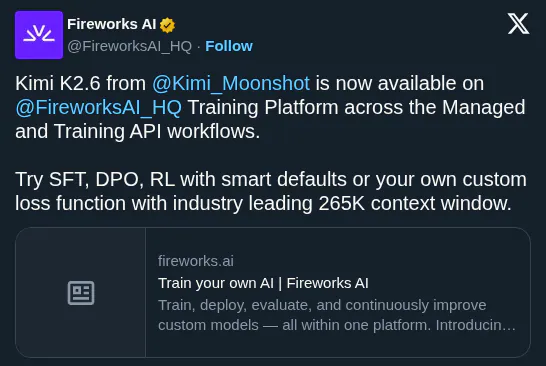
๐ ๐ฎ๐ฅ๐ฅ-๐๐๐ซ๐๐ฆ ๐๐ ๐ง๐จ๐ฐ ๐๐ฏ๐๐ข๐ฅ๐๐๐ฅ๐ ๐๐จ๐ซ ๐๐ข๐ฆ๐ข ๐๐.๐ You've been told only 3 AI labs matter. The best AI apps never believed that. @cursor_ai, @vercel, @genspark_ai don't run only off-the-shelf models. They train on open-source bases with their own data and run continuous RL to pull ahead. LoRA gets you in the door. Full-param RL is true model ownership for the maximum data moat. Today, Kimi K2.6 full param tuning is now available on Fireworks Training. 256K context. Train the whole thing. Ready to get started? https://t.co/due6j5oNBl
Fireworks AI Launches Full Parameter RL Training for Kimi K2.6
Fireworks AI, an inference platform for fast model serving and training, launched full-parameter reinforcement learning (RL) for Kimi K2.6. While Fireworks AI's Day-0 Kimi K2.6 support focused on inference, this update enables tuning the entire 1-trillion parameter set rather than relying on adapters.
- Model
- Kimi K2.6
- Total parameters
- 1 trillion
- Active parameters
- 32 billion (MoE)
- Context window
- 256K tokens
- Availability
- Private preview
This shift allows teams to build proprietary data moats by owning the model's core behavior. By training on an open-weight base with specialized data, companies can create models that outperform generic frontier APIs. The platform utilizes Fireworks AI's delta-compressed weight updates to sync training and inference clusters across fragmented GPU capacity.
You can implement custom loss functions and rewards in Python while Fireworks manages the distributed GPU infrastructure and FSDP. The Training API is in private preview, supporting the model's native 256K context window for long-horizon agentic tasks. Access is available by request through the Fireworks contact portal.
Fireworks AI
@FireworksAI_HQ
5retweets72likes
View on XStill wondering? A few quick answers below.
It is a training method that allows developers to update all weights of the 1-trillion parameter Kimi K2.6 model simultaneously. Unlike LoRA, which uses smaller adapters, full-parameter tuning enables deeper model ownership and the creation of proprietary data moats by optimizing the entire model for specific agentic or coding tasks.
The API uses a service-mode architecture where you write training logic, such as custom loss and reward functions, in plain Python on your local machine. Fireworks handles the heavy lifting, including GPU provisioning, distributed forward and backward passes, and sharding model parameters across chips using Fully Sharded Data Parallel techniques.
The Training API for Kimi K2.6 is currently in private preview. Interested developers and organizations must request early access through the Fireworks AI website to begin using the platform. Once granted access, users can leverage the 256K context window to build specialized models for long-horizon agentic workflows.
Fireworks supports the full 256K token context window for Kimi K2.6 during training. This allows the model to process and learn from massive datasets, which is essential for long-horizon tasks like autonomous coding or complex document analysis where maintaining coherence over long sequences of information is a primary requirement.
Fireworks uses a distributed architecture that employs delta-compressed weight updates to synchronize training and inference clusters. By only shipping the small percentage of weights that change between checkpoints, the platform reduces the bandwidth and compute costs typically associated with training frontier-scale models like the 1-trillion parameter Kimi K2.6.